KEY HEADLINES & INSIGHTS
GCB Bank hosted a delegation from the Bank of Uganda to strengthen regional financial market collaboration and knowledge sharing. The engagement focused on Ghana’s financial systems, including government securities trading, settlement processes, and treasury operations, while also discussing market transparency, risk management, and efficiency. Both institutions emphasized the importance of cooperation among African central banks and financial institutions to develop stronger, more integrated capital markets that support investment and economic growth.
The Producer inflation in Ghana rose to 5.8% in May 2026, prompting the Ghana Statistical Service (GSS) to call for tighter supply-chain monitoring to prevent rising production costs from feeding into consumer prices.The increase was mainly driven by mining, transport, and manufacturing, with mining and quarrying recording the highest inflation at 11%, particularly from crude oil and natural gas extraction. Other sectors like construction and services also saw renewed price increases after earlier declines. Although prices fell slightly month-on-month, GSS warned that persistent cost pressures could affect the wider economy, urge stronger oversight of key sectors and encouraging businesses to use measures like bulk purchasing and forward contracts to manage costs.
The Bank of Ghana says tokenisation of real-world assets could help deepen capital markets, improve access to finance, and boost financial inclusion by allowing physical and financial assets to be traded digitally on blockchain platforms.According to the BoG, digital assets are already widely used in Ghana, and proper regulation—such as the Virtual Asset Providers Act, 2025—is being introduced to balance innovation with financial stability and consumer protection. The central bank also sees opportunities in cheaper cross-border payments and improved financial inclusion, while stressing that digital innovation must support, not replace, the cedi and the broader monetary system.
PRIMARY DEBT MARKET ISSUANCE
WEEK
Yields on Government of Ghana treasury bills rose across all tenors this week, driven mainly by tighter liquidity conditions and stronger yield repricing at auctions. The 91-day bill increased to 5.31% (+26.31bps), the 182-day bill rose slightly to 7.13% (+5.13bps), and the 364-day bill climbed to 11.36% (+38.51bps), recording the largest gain as investors demanded higher returns for longer maturities.
| Security | Current Wk % | Previous Wk % |
|---|---|---|
| 91-Day GoG Bill | 5.3054 | 5.0423 |
| 182-Day GoG Bill | 7.1317 | 7.0804 |
| 364-Day GoG Bill | 11.3612 | 10.9761 |
Source(s): Bank of Ghana
GHANA FIXED INCOME MARKET VOLUME TRADED
The Ghana Fixed Income Market (GFIM) recorded a total trading volume of GH₵10.91 billion across 1,675 transactions during the week.Market activity was mainly driven by DDEP Bonds (49.15%) and Treasury Bills (42.69%), reflecting continued investor preference for government-backed and relatively liquid instruments. Treasury Bills also dominated transaction counts at 80.18%, due to their short-term nature and frequent trading, while DDEP Bonds contributed 14.15%. Sell/Buy Back Trades (6.19%) and Corporate Bonds (1.54%) played a smaller role, as they are typically less frequently traded, while New GoG Notes & Bonds remained marginal at 0.43%.
Daily Volume (GHS) Traded – GFIM
Week's Yield Curve
EQUITY MARKET
Trading activity on the local stock exchange was mixed this week, with share volume declining by 27.40% to 13.36 million shares from 18.40 million shares the previous week, while traded value fell by 33.26% to GH₵108.95 million from GH₵163.25 million. Telecommunications led trading by volume with 7.30 million shares, while financial stocks dominated by value at GH₵58.28 million. Most sectors recorded trading activity, with only Advertising posting no trades during the week.
| Index | Level | WoW% | MoM% | YoY% |
|---|---|---|---|---|
| GSE-CI | 14,769.2700 | 2.572 | 2.892 | 68.402 |
| FSI | 8,395.1300 | 4.0462 | 6.897 | 80.650 |
| Market Cap | 288.2389 | 5.887 | 9.623 | 67.539 |
Source(s): Ghana Stock Exchange
Week's Equities Top Gainers & Laggards
EQUITY MARKET MOST TRADED STOCKS
| Ticker | Traded Volume | Price (GHS) |
|---|---|---|
| MTNGH | 7,303,645.00 | 6.41 |
| ETI | 2,000,268.00 | 2.28 |
| CAL | 1,775,713.00 | 0.82 |
| GCB | 1,404,382.00 | 36.00 |
| KASA | 337,070.00 | 1.91 |
Source(s): Ghana Stock Exchange
TOP PERFORMING AFRICAN STOCK INDICES
| Country | Index | Level | YTD % |
|---|---|---|---|
| Ghana | GSE-CI | 14,769.27 | 68.40 |
| Nigeria | NGX ASI | 235,941.27 | 51.62 |
| Zimbabwe | ZSE-ASI | 400.04 | 43.97 |
| Tanzania | DSE -ASI | 3,940.49 | 42.67 |
| Rwanda | RSE -ASI | 255.05 | 39.94 |
Source(s): African Markets
COMMODITY MARKET
This week, the commodities market recorded mixed performance across the three major commodities tracked. Brent crude oil closed at $79.85, posting a sharp weekly decline of 8.57%, with losses extending to the monthly (13.25%) and quarterly (32.53%) periods. Despite these declines, Brent remained up 31.22% year-on-year, supported by earlier price gains.
Gold closed at $4,224.10, recording a marginal weekly gain of 0.22%. However, the precious metal remained under pressure over the month (-7.38%), quarter (-9.11%), and year (-2.35%), reflecting weaker investor sentiment.
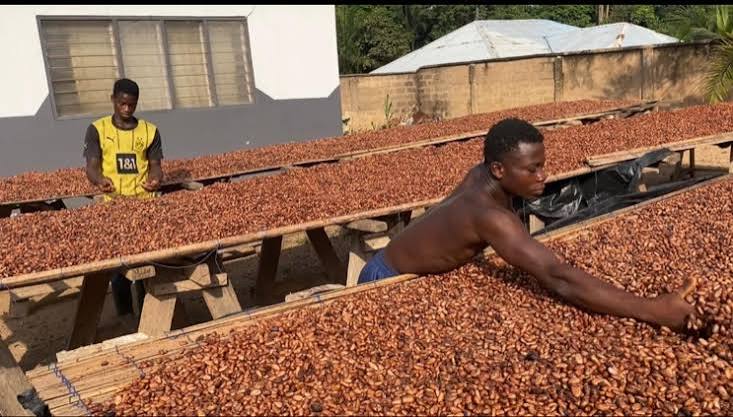
In contrast, cocoa emerged as the best performer, ending the week at $4,143 with a strong weekly return of 9.63%. The commodity also posted positive monthly (5.61%) and quarterly (25.55%) returns, although it remained 31.69% lower year-on-year.
Source(s): Yahoo Finance, Trading Economics
CURRENCY MARKET
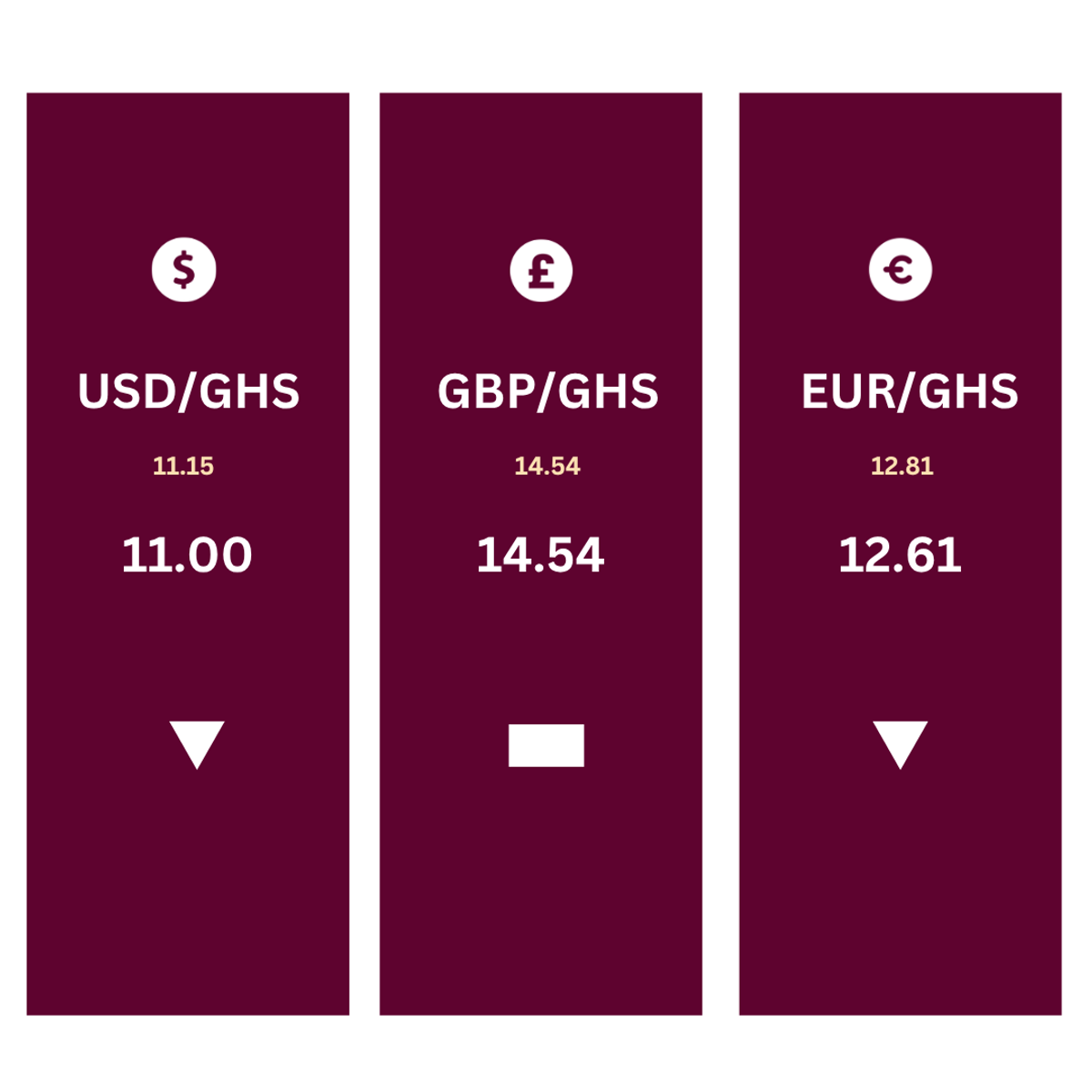
The Ghanaian cedi strengthened against two of the major trading currencies during the week ended June 22, 2026. The USD/GHS rate declined by 1.35% week-on-week to GH₵11.00, while the EUR/GHS rate fell by 1.60% to GH₵12.61, reflecting an appreciation of the cedi against both currencies. Meanwhile, the GBP/GHS rate remained unchanged at GH₵14.54, posting a weekly return of 0.00%. The cedi's gains were supported by improved foreign exchange liquidity, sustained inflows from remittances and gold exports, as well as continued confidence in Ghana's macroeconomic outlook and ongoing fiscal reforms.
Source(s): Bank of Ghana