KEY HEADLINES & INSIGHTS
The government of Ghana plans to buy back Domestic Debt Exchange Programme (DDEP) bonds maturing in 2027 as part of efforts to manage its growing debt obligations. According to the Bank of Ghana’s issuance calendar for October to December 2026, the move comes as the government faces GH¢58.4 billion in debt-service obligations. The planned buybacks are expected to help manage upcoming repayments and ease pressure on public finances as the government works to maintain debt sustainability.
Dr. David Ofosu-Dorte, Senior Partner at AB & David Africa, has called on the Institute of Chartered Accountants, Ghana (ICAG), to abolish the six-year auditor rotation rule. He argues that the requirement places an unnecessary financial and administrative burden on small and medium sized enterprises (SMEs). He believes reviewing the rule could reduce costs and make auditing requirements less burdensome for smaller businesses.
Investors are closely monitoring earnings from major technology firms such as Microsoft, Alphabet and Amazon to determine whether their heavy investments in artificial intelligence will deliver strong returns. Meanwhile, easing oil prices are helping support financial markets following recent volatility.
Investor Jared Carmel believes Anthropic could be worth as much as $2 trillion, citing its rapid revenue growth and role in AI infrastructure. Its IPO performance could also influence investor confidence in OpenAI and the wider artificial intelligence market.
PRIMARY DEBT MARKET ISSUANCE WEEK
Yields on Government of Ghana Treasury bills declined across all three tenors in the latest auction held on 23 October 2026 for securities to be issued on 26 October 2026. The 91-day bill yield fell to 4.6135% from 4.6235% previously, while the 182-day bill declined to 6.2929% from 6.3154%. The 364-day bill also eased to 9.6739% from 9.7135%. Total bids tendered amounted to GH¢4.267 billion (GH¢2.860 billion for the 91-day bill, GH¢533.28 million for the 182-day bill and GH¢873.69 million for the 364-day bill), compared with the government’s target of GH¢3.798 billion, while GH¢3.393 billion was accepted. Overall, yields declined across the Treasury bill curve, with the largest reduction recorded on the 364-day bill at 3.96 basis points, followed by the 182-day bill at 2.25 basis points and the 91-day bill at 1.00 basis point.
| Security | Current Wk % | Previous Wk % | Bps |
|---|---|---|---|
| 91-Day GoG Bill | 4.6135 | 4.6235 | -1.00 |
| 182-Day GoG Bill | 6.2929 | 6.3154 | -2.25 |
| 364-Day GoG Bill | 9.6739 | 9.7135 | -3.96 |
Source(s): Bank of Ghana
GHANA FIXED INCOME MARKET VOLUME TRADED
The Ghana Fixed Income Market (GFIM) recorded approximately GH₵13.75 billion in traded volume across 3,987 transactions during the week. DDEP Bonds accounted for the largest share of turnover at 66.27%, representing 8.03% of all transactions, indicating that trading was concentrated in relatively large value deals. Treasury Bills contributed 29.52% of total traded volume while dominating transaction activity with 88.79% of all trades, reflecting their continued importance as highly liquid short-term government securities. Sell/Buy Back Trades involving all GoG Notes and Bonds accounted for 4.01% of turnover and 2.08% of transactions. Corporate Bonds contributed 0.11% of traded volume and 0.75% of transactions, while New GoG Notes and Bonds accounted for 0.09% of volume and 0.08% of transactions. Commercial Paper and Old GoG Notes and Bonds each accounted for less than 0.01% of traded volume. Overall, trading activity remained concentrated in DDEP Bonds and Treasury Bills, which together accounted for 95.79% of total traded volume, with Treasury Bills overwhelmingly dominating transaction activity throughout the week.
Daily Volume (GHS) Traded – GFIM
Week's Yield Curve
EQUITY MARKET
Trading activity on the Ghana Stock Exchange recorded approximately 12.36 million shares traded at a total value of GH₵56.41 million during the week from 19 to 23 October 2026. The Telecommunications sector led market activity with 7.36 million shares valued at GH₵47.93 million, accounting for approximately 84.96% of total traded value and 59.60% of total shares traded. The Financial sector followed with 3.58 million shares worth GH₵5.24 million, while Healthcare recorded 406,741 shares valued at GH₵309,345.01. Advertising traded 219,746 shares worth GH₵97,237.46, while Insurance recorded 170,352 shares valued at GH₵1.18 million. Oil & Gas traded 44,890 shares worth GH₵336,787.35, followed by Agriculture with 13,224 shares valued at GH₵62,339.78. Technology accounted for 13,164 shares valued at GH₵52,656.00, while Food & Beverage recorded 10,290 shares worth GH₵153,078.82. Manufacturing traded 8,000 shares worth GH₵3,040.00, while Mining recorded 6,810 shares valued at GH₵38,410.65. Education recorded minimal activity, with 2,000 shares traded at a value of GH₵280.00. Overall, market activity remained heavily concentrated in Telecommunications, which dominated both traded volume and value, while the Financial sector ranked second in traded volume and value among the reported sectors.
| Index | Level | WoW% | MoM% | YoY% |
|---|---|---|---|---|
| GSE-CI | 14,107.5800 | -1.995 | -0.240 | 60.857 |
| FSI | 7,428.5300 | -0.934 | -1.668 | 59.851 |
| Market Cap (Bn) | 266.7203 | -1.672 | -1.338 | 55.032 |
Source(s): Ghana Stock Exchange
Week's Equities Top Gainers & Laggards
EQUITY MARKET MOST TRADED STOCKS
| Ticker | Traded Volume | Price (GHS) |
|---|---|---|
| MTNGH | 7,364,534.00 | 6.52 |
| CAL | 3,090,135.00 | 0.74 |
| KASA | 505,776.00 | 1.81 |
| ETI | 391,724.00 | 1.51 |
| DIGICUT | 219,746.00 | 0.43 |
Source(s): Ghana Stock Exchange
TOP PERFORMING AFRICAN STOCK INDICES YEAR-TO-DATE
| Country | Index | Level | YTD % |
|---|---|---|---|
| Zimbabwe | ZSE-ASI | 480.97 | +73.10 |
| Tanzania | DSE-ASI | 4,539.27 | +64.35 |
| Ghana | GSEC-CI | 14,107.58 | +60.86 |
| Uganda | USE-ASI | 2,607.51 | +59.79 |
| Nigeria | NGX-ASI | 247,222.27 | +58.87 |
Source(s): African Markets
COMMODITY MARKET
Commodity markets diverged this week, with Brent crude rising 6.24% to US$116.72 per barrel, up 12.74% over the month and quarter and 91.82% year-on-year. The rally was driven by Houthi attacks on Saudi Arabia’s energy infrastructure and tankers near the Strait of Hormuz. In contrast, gold fell 4.14% to US$4,007.90 per ounce, declining 4.27% over the month and quarter and 7.68% year-on-year, as inflation concerns and expectations of higher US interest rates weighed on prices. Cocoa also declined by 0.94% to US$5,592 per tonne, despite gains of 4.19% over the month and quarter, while remaining 7.8% lower year-on-year.
In Ghana, these developments have mixed implications for export earnings, foreign exchange inflows and inflation. Lower gold and cocoa prices could weaken export revenues, while higher oil prices may increase fuel and transportation costs. According to the Chamber of Oil Marketing Companies (COMAC), petrol and diesel prices were projected at GH¢17.67 and GH¢19.30 per litre, respectively, for the 16 October pricing window. However, continued increases in global oil prices and cedi depreciation could put upward pressure on domestic fuel prices. These risks come as inflation rose to 5.2% in September from 5.0% in August, while the Bank of Ghana maintained its policy rate at 14%.
Globally, commodity markets remain sensitive to geopolitical tensions, supply conditions and expectations of US monetary policy. For Ghana, higher oil prices alongside weaker gold prices and cocoa’s year-on-year decline could increase external pressures and complicate inflation management. Market attention is focused on the US Federal Reserve’s decision on 28 October and US inflation data due on 29 October, which could influence commodity prices, investor sentiment and Ghana’s economic outlook.
Source(s): Yahoo Finance, Trading Economics
CURRENCY MARKET
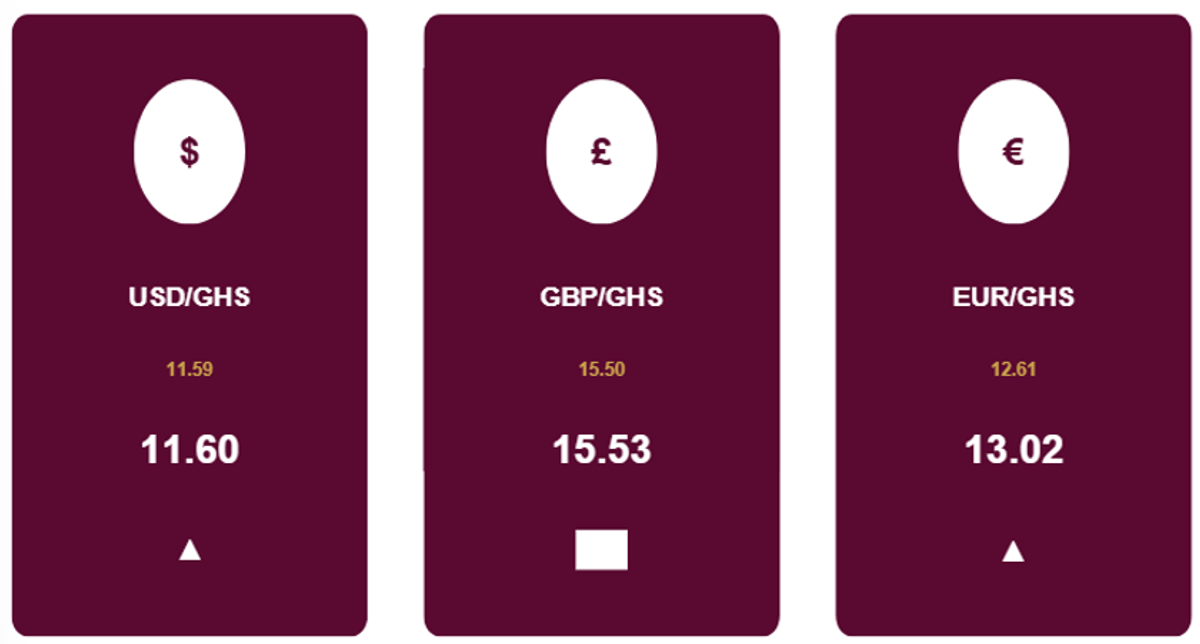
The Ghanaian cedi recorded mixed movements against major trading currencies during the week. The USD/GHS rate stood at GH¢11.60, with the cedi depreciating by 0.09% week-on-week but appreciating by 0.77% over the month and quarter. However, the cedi weakened by 6.42% year-on-year against the US dollar.
The EUR/GHS rate stood at GH¢13.02, reflecting a weekly depreciation of 3.30%, while the cedi weakened by 0.90% over the month and quarter and 5.63% year-on-year.
Meanwhile, the GBP/GHS rate stood at GH¢15.53, with no recorded changes across the weekly, monthly, quarterly or yearly periods. Recent developments indicate that increased foreign exchange supply from the Ghana Gold Board (GoldBod) has supported the cedi by improving dollar liquidity, while import financing and energy-related payments continue to influence foreign exchange demand. Overall, the supplied data indicate mixed performance against the US dollar, depreciation against the euro, and no change against the pound.
Source(s): Bank of Ghana