KEY HEADLINES & INSIGHTS
Trading on the Ghana Stock Exchange this week was mixed. Share volume rose 2.24% to 11,762,657 shares, but total traded value fell sharply by 23.54% to GH₵66.21 million, pointing to activity in lower-priced stocks. Both indices retreated, with the GSE-CI down 3.72% to 14,567.57 and the FSI shedding 5.96% to 8,312.72. MTNGH dominated trading with nearly 8 million shares exchanged at GH₵6.53.
The Bank of Ghana maintains a monetary policy rate of 14.00%, with an inflation target of 8.0% ± 2. Current inflation has eased significantly to 3.4%, falling well within the target band, reflecting improving price stability in the economy. This favorable inflation environment provides the central bank with room to consider further easing, which could support economic activity and boost investor sentiment in the near term.
The Ghana Fixed Income Market recorded a strong GH₵5.04 billion in total volume across 1,941 transactions. Treasury Bills led activity, accounting for 44.17% of volume and 86.97% of all transactions, reflecting sustained investor preference for short-term instruments. Yields were mixed, the 91-day bill stood at 4.8243%, the 364-day bill eased to 10.1302%, while the 182-day bill edged up by 6.69 basis points to 7.0384%.
Commodities told contrasting stories, with gold gaining approximately $200 over the week to close at $4,720.40 per troy ounce amid safe haven demand, while Brent crude slid from $114.44 to $101.29 per barrel on global growth concerns. Cocoa surged mid-week to $4,356 per ton before pulling back to $4,113 on profit taking. On the currency front, the cedi depreciated 0.59% against the dollar to 11.28 and 0.27% against the euro to 13.26, with the steepest annual loss of 7.56% recorded against the euro. Despite these pressures, Ghana leads African equity markets with an impressive year-to-date return of 66.10% on the GSE-CI.
PRIMARY DEBT MARKET ISSUANCE WEEK
Yields on Government of Ghana (GoG) treasury bills recorded mixed movements across the curve in the current week. The 91-day bill declined marginally by 4.01 basis points to 4.8832%, reflecting continued stability in short-term borrowing costs. The 182-day bill edged up by 6.69 basis points to 7.0384%, indicating a slight increase in medium-term rates. Meanwhile, the 364-day bill fell by 6.65 basis points to 10.1302%, suggesting some easing in longer-term yields.
| Security | Current Wk % | Previous Wk % |
|---|---|---|
| 91-Day GoG Bill | 4.8832 | 4.9233 |
| 182-Day GoG Bill | 7.0384 | 6.9715 |
| 364-Day GoG Bill | 10.1302 | 10.1967 |
Source(s): Bank of Ghana
GHANA FIXED INCOME MARKET VOLUME TRADED
The Ghana Fixed Income Market (GFIM) recorded a total trading volume of GH₵5.04 billion at the close of the week, across 1,941 transactions. Treasury Bills dominated market activity, accounting for 44.17% of total traded volume and 86.97% of total transactions, underscoring sustained investor preference for short-term instruments. Sell/Buy Back Trades in Government of Ghana (GoG) Notes and Bonds followed, contributing 30.82% of total traded volume and 7.32% of total deals. DDEP Bonds represented 22.05% of market volume but only 3.35% of transactions, reflecting relatively large-sized trades within the segment.
New GoG Notes and Bonds accounted for 2.79% of total traded volume and 0.93% of total transactions. Meanwhile, Corporate Bonds recorded a marginal share of 0.16% of traded volume and 1.13% of transactions, while Old GoG Notes and Bonds contributed just 0.01% of total volume and 0.31% of total deals, indicating limited activity in these segments.
Daily Volume (GHS) Traded – GFIM
Week's Yield Curve
EQUITY MARKET
This week, trading on the local stock exchange showed mixed performance in activity, as total share volume increased by 2.24% to reach 11,762,657 shares, compared to last week's 11,505,467 shares. In tandem, the total traded value declined by 23.54%, dipping to GH₵66.21 million from the previous week's GH₵86.54 million, indicating lower-value transactions.
| Index | Level | WoW% | MTD% | YTD% |
|---|---|---|---|---|
| GSE-CI | 14,567.570 | -3.721 | -3.721 | 66.102 |
| FSI | 8,312.720 | -5.958 | -5.958 | 78.877 |
| Market Cap | 268.907 | -4.587 | 4.587 | 56.303 |
Source(s): Ghana Stock Exchange
Week's Equities Top Gainers & Laggards
EQUITY MARKET MOST TRADED STOCKS
| Ticker | Traded Volume | Price (GHS) |
|---|---|---|
| MTNGH | 7,994,444.00 | 6.53 |
| CAL | 1,276,581.00 | 0.81 |
| ETI | 1,196,616.00 | 1.60 |
| HORDS | 431,353.00 | 0.10 |
| ZEN | 319,259.00 | 7.36 |
Source(s): Ghana Stock Exchange
TOP PERFORMING AFRICAN STOCK INDICES
| Country | Index | Level | YTD % |
|---|---|---|---|
| Ghana | GSE-CI | 14,567.57 | ▲ 66.10 |
| Nigeria | NGX ASI | 242,775.83 | ▲ 57.30 |
| Tanzania | DSE ASI | 3,814.16 | ▲ 38.10 |
| Zimbabwe | ZSE ASI | 375.15 | ▲ 35.01 |
| Tunisia | TUNINDEX | 16,526.74 | ▲ 22.88 |
Source(s): African Market
COMMODITY MARKET
This week, the commodities market exhibited mixed performance across key assets. Brent crude oil prices trended downward over the week, declining from $114.44 per barrel on May 4to $109.87 per barrel on May 5, before falling further to $101.27 per barrel on May 6 and reaching a weekly low of $100.06 per barrel on May 7, before slightly recovering to close the week at $101.29 per barrel on May 8, reflecting sustained bearish pressure driven by demand concerns and global growth uncertainty. Gold prices recorded a steady upward trajectory throughout the week, rising from $4,519.50 per troy ounce on May 4 to $4,555.80 per troy ounce on May 5, climbing further to $4,681.90 per troy ounce on May 6 and $4,699.80 per troy ounce on May 7, before closing the week at $4,720.40 per troy ounce on May 8, a notable weekly gain of approximately $200 per troy ounce reflecting strong safe-haven demand amid global market uncertainty and a softer dollar environment.
Cocoa prices displayed high volatility throughout the week, rising from $3,812.00 per ton on May 4 to $4,003.00 per ton on May 5, before climbing further to $4,064.00 per ton on May 6 and surging to a weekly peak of $4,356.00 per ton on May 7, before pulling back sharply to close at $4,113.00 per ton on May 8, representing a weekly gain of approximately $301 per ton suggesting strong mid-week buying momentum followed by profit-taking and short-term supply-side fluctuations into the week's close.
Source(s): Yahoo Finance, Trading Economics
CURRENCY MARKET
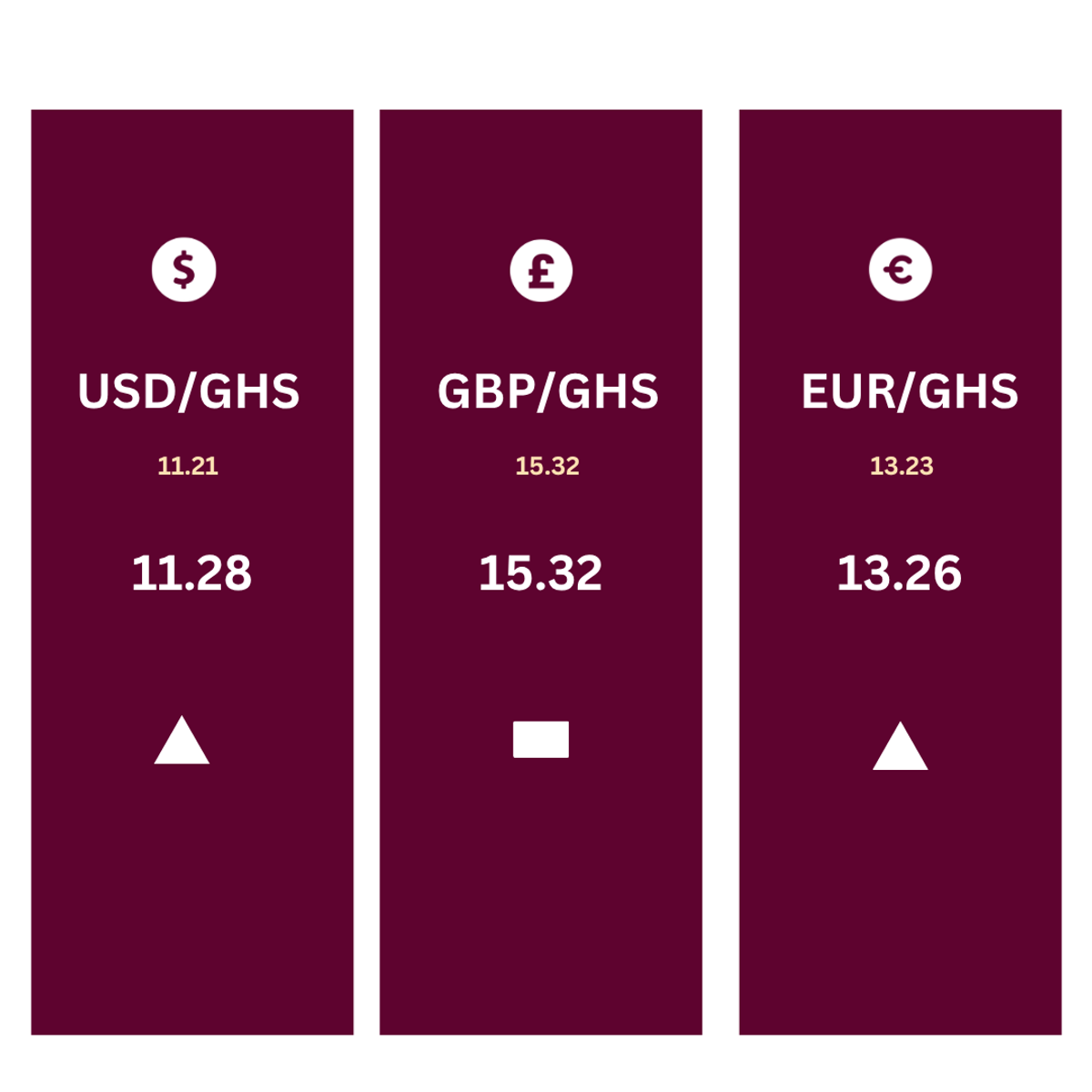
Exchange rates reflected continued depreciation pressures on the Ghanaian cedi across major currency pairs. The USD/GHS rate stood at 11.28, reflecting a weekly depreciation of 0.59%, a monthly decline of 0.89%, and a quarterly loss of 2.64%, with the cedi losing 3.49% against the US dollar on a yearly basis. The EUR/GHS rate closed at 13.26, with the cedi weakening 0.27% over the week, 1.41% over the month, and 5.62% over the quarter, representing a yearly depreciation of 7.56% against the euro — the steepest annual decline among the three pairs. The GBP/GHS rate stood at 15.32, with no recorded movement across all time horizons, suggesting either a stable peg dynamic or limited trading activity in that pair during the period. Overall, the cedi's persistent depreciation against the dollar and euro signals continued currency pressure, which may weigh on import costs, inflation, and investor sentiment in the near term.
Source(s): Bank of Ghana