KEY HEADLINES & INSIGHTS
- Ghana’s 2027 Budget aims to turn economic recovery, supported by 5.5% inflation and 5.7% projected GDP growth in 2026, into sustainable jobs, increased investment and improved living standards while maintaining fiscal stability.
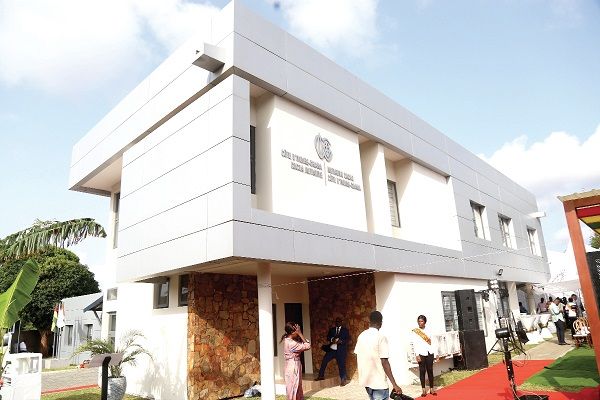
- GCB Bank is expanding support for MSMEs through financing, digital payment solutions and business development initiatives to improve access to capital, strengthen operations and help local businesses grow.
- The Ministry of Trade, Agribusiness and Industry ranked last among 23 ministries due to poor service delivery and low staff efficiency, highlighting weaknesses in its institutional performance.
- ADB has launched the Green Grow Vegetable Farmers Lending Scheme to provide smallholder farmers with better access to financing, increase local vegetable production and support agricultural growth in Ghana.
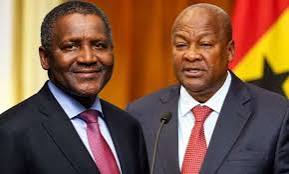
- President Mahama and Aliko Dangote will lead the Invest Ghana Summit 2026 on November 16–17 in Accra, bringing global investors together to explore opportunities across key sectors, support Ghana’s $10 billion investment programme (2026–2030) and promote industrialisation, job creation and economic growth.
- Chinese banks are raising US dollar deposit rates to encourage people and exporters to hold dollars instead of yuan, helping slow the yuan’s rapid appreciation and protect Chinese exporters from shrinking profit margins.
PRIMARY DEBT MARKET ISSUANCE WEEK
Yields on Government of Ghana Treasury bills declined across all three tenors in the latest auction held on 6 November 2026 for securities to be issued on 9 November 2026. The 91-day bill yield fell to 4.5624% from 4.6013% previously, representing a decline of 3.89 basis points. Similarly, the 182-day bill yield declined to 6.2020% from 6.2629%, a reduction of 6.09 basis points, while the 364-day bill yield eased to 9.4846% from 9.6039%, representing a decline of 11.93 basis points. Total bids tendered amounted to GH¢5.012 billion, comprising GH¢3.004 billion for the 91-day bill, GH¢1.619 billion for the 182-day bill and GH¢388.45 million for the 364-day bill, against the government’s target of GH¢3.543 billion. Of the total bids tendered, GH¢4.107 billion was accepted. Overall, yields declined across the Treasury bill curve, with the largest reduction recorded on the 364-day bill at 11.93 basis points, followed by the 182-day bill at 6.09 basis points and the 91-day bill at 3.89 basis points.
| Security | Current Wk % | Previous Wk % | Bps |
|---|---|---|---|
| 91-Day GoG Bill | 4.5624 | 4.6013 | - 3.89 |
| 182-Day GoG Bill | 6.2020 | 6.2629 | - 6.09 |
| 364-Day GoG Bill | 9.4846 | 9.6039 | -11.93 |
Source(s): Bank of Ghana
GHANA FIXED INCOME MARKET VOLUME TRADED
The Ghana Fixed Income Market (GFIM) recorded approximately GH¢7.53billion in traded volume across 2,057 transactions during the week. Treasury Bills dominated trading activity, accounting for 60.49% of total traded volume (GH¢4.55 billion) and 85.37% of transactions. DDEP Bonds followed with GH¢2.78 billion, representing 36.89% of traded volume and 5.25% of transactions. Sell/Buy Back Trades accounted for 2.00% of turnover, while Corporate Bonds, Commercial Paper and New GoG Notes and Bonds contributed 0.45%, 0.15% and 0.01%, respectively. Old GoG Notes and Bonds recorded minimal activity, while no trades were recorded in Green & Sustainable Bonds. Overall, Treasury Bills and DDEP Bonds jointly accounted for 97.38% of total traded volume, highlighting their dominance in the week’s fixed income market activity.
Daily Volume (GHS) Traded – GFIM
Week's Yield Curve
EQUITY MARKET
Trading activity on the Ghana Stock Exchange recorded approximately 19.18 million shares traded at a total value of GH¢69.61 million during the week. The Financial sector dominated market activity, recording 12.47 million shares valued at GH¢43.44 million, accounting for approximately 62.40% of total traded value and 65.00% of total shares traded. The Telecommunications sector followed with 2.78 million shares worth GH¢18.39 million, the second highest contribution to traded value. Advertising recorded 382,369 shares valued at GH¢129,389.79, while Healthcare traded 268,217 shares worth GH¢157,991.07. Insurance recorded 80,194 shares valued at GH¢495,230.45, followed by Manufacturing with 53,135 shares worth GH¢24,633.55. Oil & Gas accounted for 49,174 shares traded at GH¢669,504.75, while Food & Beverage recorded 43,284 shares valued at GH¢639,708.95. Agriculture traded 18,967 shares worth GH¢42,117.19, Technology recorded 5,408 shares valued at GH¢20,819.55, Education traded 4,549 shares worth GH¢704.68, and Mining recorded 3,850 shares valued at GH¢36,880.70. Overall, market activity remained heavily concentrated in the Financial sector, which accounted for the largest share of both trading volume and value, followed by the Telecommunications sector, which together accounted for 88.83% of total traded value.
| Index | Level | WoW% | MoM% | YoY% |
|---|---|---|---|---|
| GSE-CI | 14,000.3700 | -2.111 | -2.111 | 59.635 |
| FSI | 7,269.2200 | -1.610 | -1.610 | 56.423 |
| Market Cap (Bn) | 263.2747 | -1.819 | -1.819 | 53.029 |
Source(s): Ghana Stock Exchange
Week's Equities Top Gainers & Laggards
EQUITY MARKET MOST TRADED STOCKS
| Ticker | Traded Volume | Price (GHS) |
|---|---|---|
| ETI | 10,306,645.00 | 1.39 |
| KASA | 3,006,609.00 | 1.78 |
| MTNGH | 2,779,395.00 | 6.58 |
| CAL | 1,302,816.00 | 0.75 |
| GCB | 733,630.00 | 42.00 |
Source(s): Ghana Stock Exchange
KEY MACROECONOMIC INDICATORS
| Indicator | Value (%) |
|---|---|
| Current Monetary Policy Rate | 14.00 |
| Inflation Target (%) | 6.0 – 10.0 |
| Current inflation rate (%) | 5.5 |
Source(s): Bank of Ghana
COMMODITY MARKET
- Commodity markets recorded mixed performance during the week, with crude oil and cocoa prices declining while gold recovered. Brent crude fell by 16.42% to US$98.32 per barrel, although it remained 61.58% higher year-to-date and 55.13% above its level a year earlier. The decline reflected easing geopolitical risk premiums, reduced supply concerns and expectations of weaker demand, amid developments in US-Iran relations.
- Gold prices increased by 4.51% to US$4,074.90 per ounce, supported by renewed safe haven demand and market uncertainty. However, gold remained 6.13% lower year-to-date, despite recording a 2.10% year-on-year gain.
- Cocoa prices declined by 5.46% to US$5,155 per tonne, extending their year-to-date and year-on-year losses to 15.00% and 16.65%, respectively. The decline reflected rising global inventories and concerns about weaker chocolate demand, although unfavourable weather conditions in West Africa could affect future supply.
- For Ghana, the developments present mixed implications for export earnings and foreign exchange inflows. Lower crude oil prices could reduce petroleum export receipts but ease fuel import costs, while gold's recovery provides some support to export earnings. Continued weakness in cocoa prices, however, could constrain export revenue, particularly amid domestic production challenges. Overall, the performance highlights the exposure of Ghana's external sector to fluctuations in global commodity prices.
Source(s): Yahoo Finance, Trading Economics
CURRENCY MARKET
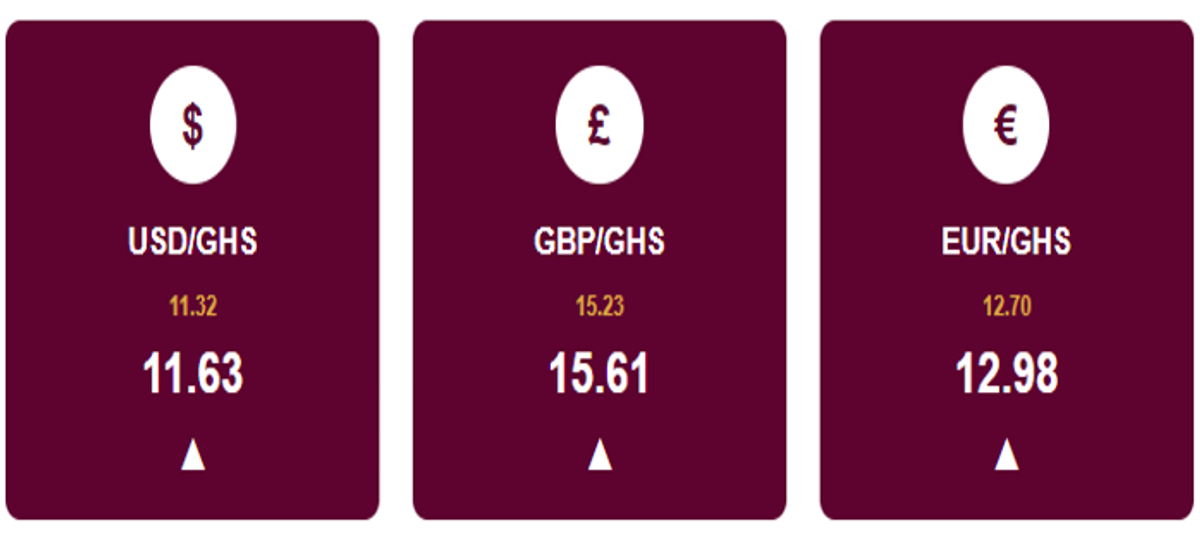
- The Ghanaian cedi weakened against all three major trading currencies over the week, with mixed movements over the month and quarter. The USD/GHS exchange rate stood at GH¢11.63, with the cedi depreciating by 2.72% week-to-date and appreciating by 0.09% over the month and by 0.51% over the quarter. Year-to-date, the cedi weakened by 6.70% against the US dollar.
- The EUR/GHS rate stood at GH¢12.98, reflecting a week-to-date depreciation of 2.18%. The cedi also depreciated by 3.16% over the month and by 0.54% over the quarter. Year-to-date, the cedi weakened by 5.25% against the euro.
- Meanwhile, the GBP/GHS rate stood at GH¢15.61, with the cedi depreciating by 2.44% week-to-date, 0.22% over the month and 0.65% over the quarter. Year-to-date, the cedi weakened by 6.32% against the British pound. Overall, the cedi weakened against the US dollar, euro and British pound over the week, with the USD/GHS pair the only one showing cedi appreciation over the month and quarter.
Source(s): Bank of Ghana