KEY HEADLINES & INSIGHTS
- The Bank of Ghana will introduce redesigned cedi notes on December 1, 2026, featuring improved security, durability and smaller sizes to strengthen public confidence in the currency.
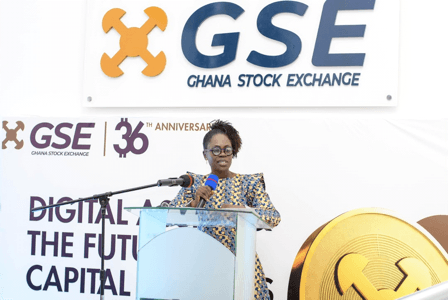
- The Ghana Stock Exchange plans to introduce tokenised assets on its trading platform, while regulators develop safeguards to protect investors and maintain market confidence.
- Government plans to stop buying liquid fuels for electricity generation by 2027, as it expands natural gas supply to power the country.
- Ghana’s public debt has risen to 47.5% of GDP as government lowers its primary surplus target to fund the US$10 billion New Economy programme, raising concerns about fiscal sustainability.
- Experts urge Ghana to strengthen its domestic capital market, institutions and policy consistency to sustain economic gains and support long term industrial growth.
- Government proposes reforms requiring at least 50% Ghanaian ownership in mining contracting companies to increase local participation in the sector.
- Global stock markets declined as investors grew cautious ahead of Nvidia’s earnings and Anthropic’s IPO, while fears of higher US interest rates added pressure.
PRIMARY DEBT MARKET ISSUANCE WEEK
Yields on Government of Ghana Treasury bills declined across all three tenors in the latest auction, held on 13 November 2026 for securities to be issued on 16 November 2026. The 91-day bill yield fell to 4.5571% from 4.5624% previously, a decline of 0.53 basis points. The 182-day bill yield declined to 6.1678% from 6.2020%, a reduction of 3.42 basis points, while the 364-day bill yield eased to 9.4603% from 9.4846%, a decline of 2.43 basis points. Total bids tendered amounted to GH¢4.333 billion, comprising GH¢2.738 billion for the 91-day bill, GH¢721.62 million for the 182-day bill and GH¢873.41 million for the 364-day bill, against the government’s target of GH¢5.572 billion. Of the total bids tendered, GH¢3.452 billion was accepted. Overall, yields declined across the Treasury bill curve, with the largest reduction recorded on the 182-day bill at 3.42 basis points, followed by the 364-day bill at 2.43 basis points and the 91-day bill at 0.53 basis points.
| Security | Current Wk % | Previous Wk % | Bps |
|---|---|---|---|
| 91-Day GoG Bill | 4.5571 | 4.5624 | - 0.53 |
| 182-Day GoG Bill | 6.1678 | 6.2020 | - 3.42 |
| 364-Day GoG Bill | 9.4603 | 9.4846 | -2.43 |
Source(s): Bank of Ghana
GHANA FIXED INCOME MARKET VOLUME TRADED
The Ghana Fixed Income Market (GFIM) recorded approximately GH¢11.43 billion in traded volume across 1,565 transactions during the week. DDEP Bonds dominated trading activity, accounting for 60.04% of total traded volume (GH¢6.86 billion) but only 6.77% of transactions. Treasury Bills followed with GH¢3.97 billion, representing 34.72% of traded volume and 81.66% of transactions. Sell/Buy Back Trades accounted for 4.93% of turnover (GH¢563.44 million), while Commercial Paper (GH¢17.92 million) and Corporate Bonds (GH¢16.90 million) contributed 0.16% and 0.15%, respectively. Old GoG Notes and Bonds contributed 0.01% (GH¢692,000), and New GoG Notes and Bonds recorded a single trade worth GH¢7,000.Green & Sustainable Bonds recorded zero trades (0.00% of volume and transactions). Overall, DDEP Bonds and Treasury Bills jointly accounted for 94.76% of total traded volume, highlighting their dominance in the week’s fixed income market activity.
Daily Volume (GHS) Traded – GFIM
Week's Yield Curve
EQUITY MARKET
Trading activity on the Ghana Stock Exchange recorded approximately 7.80 million shares traded at a total value of GH¢80.31 million during the week. The Financial sector dominated market activity, recording 3.62 million shares valued at GH¢62.70 million, accounting for approximately 78.08% of total traded value and 46.45% of total shares traded. The Telecommunications sector followed with 1.85 million shares worth GH¢12.18 million, the second highest contribution to traded value, representing 15.17% of total traded value and 23.65% of total shares traded. Manufacturing recorded 225,101 shares valued at GH¢127,717.36, while Healthcare traded 184,697 shares worth GH¢125,865.92. Insurance recorded 121,864 shares valued at GH¢774,611.00, followed by Oil & Gas with 88,187 shares worth GH¢1,300,671.09. Agriculture traded 46,840 shares worth GH¢58,463.51, while Advertising recorded 43,317 shares valued at GH¢15,312.38. Technology recorded 25,075 shares valued at GH¢89,811.98, Food & Beverage traded 8,337 shares worth GH¢129,228.98, and Mining recorded 588 shares valued at GH¢13,196.79. No trades were recorded in the Education sector. Overall, market activity remained heavily concentrated in the Financial sector, which accounted for the largest share of both trading volume and value, followed by the Telecommunications sector, which together accounted for 93.24% of total traded value.
| Index | Level | WoW% | MoM% | YoY% |
|---|---|---|---|---|
| GSE-CI | 13,960.4000 | -0.285 | -2.390 | 59.179 |
| FSI | 7,148.5200 | -1.660 | -3.243 | 53.825 |
| Market Cap (Bn) | 262.3918 | -0.335 | -2.149 | 52.516 |
Source(s): Ghana Stock Exchange
Week's Equities Top Gainers & Laggards
EQUITY MARKET MOST TRADED STOCKS
| Ticker | Traded Volume | Price (GHS) |
|---|---|---|
| CAL | 1,852,396.00 | 0.76 |
| MTNGH | 1,845,201.00 | 6.61 |
| KASA | 1,585,830.00 | 1.74 |
| GCB | 1,513,151.00 | 39.95 |
| CPC | 225,101.00 | 0.69 |
Source(s): Ghana Stock Exchange
KEY MACROECONOMIC INDICATORS
| Indicator | Value (%) |
|---|---|
| Current Monetary Policy Rate | 14.00 |
| Inflation Target (%) | 6.0 – 10.0 |
| Current inflation rate (%) | 5.5 |
Source(s): Bank of Ghana
COMMODITY MARKET
- Commodity markets were weaker during the week, with Brent crude, gold and cocoa all declining. Brent fell by 2.52% to US$95.84 per barrel, its second weekly decline, but remained 57.50% higher year-to-date and 52.10% above a year earlier. The fall reflected the IEA’s forecast of a fourth quarter supply surplus, rising US stocks and easing fears of direct conflict with Iran, though Hormuz tensions kept prices volatile.
- Gold fell by 4.63% to US$3,886.30 per ounce, its lowest level since October 2025, and is about 10% lower year-to-date and 7.5% lower year-on-year. Hotter than expected US inflation, Treasury yields near 5%, a stronger dollar and expectations of a December Fed rate hike outweighed safe haven demand.
- Cocoa declined by 0.70% to US$5,119 per tonne, with year-to date and year-on-year losses of 15.60% and about 6.7%.Rising ICE stocks and weak chocolate demand pushed prices to four-month lows on Tuesday. Delayed Ivorian deliveries and El Niño concerns limited the losses.
Source(s): Yahoo Finance, Trading Economics
CURRENCY MARKET
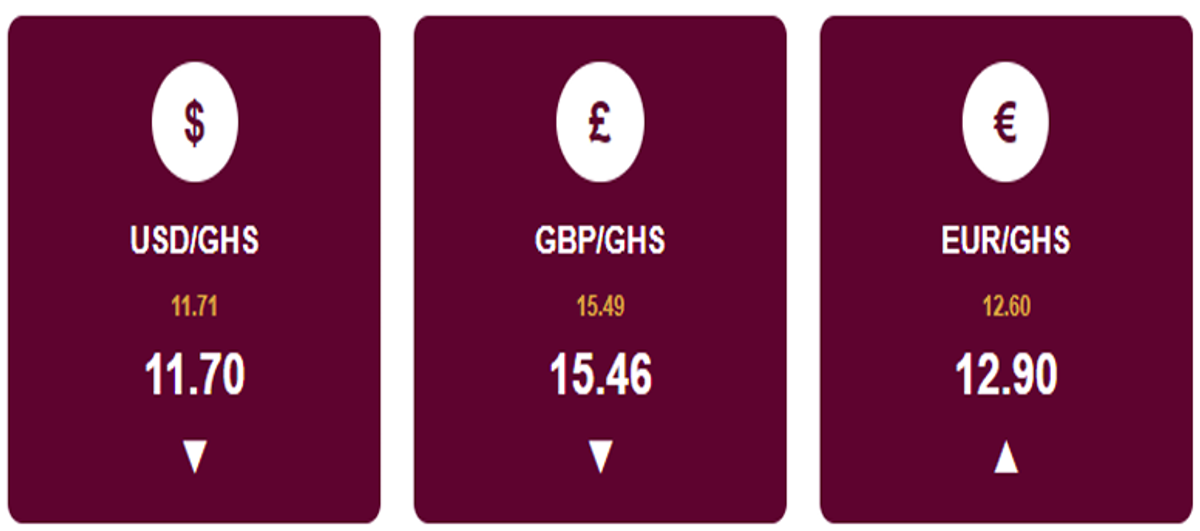
- The cedi was mixed against the three major trading currencies at the start of the week. It appreciated slightly against the US dollar and the British pound but depreciated against the euro. The USD/GHS rate stood at GH¢11.70, with the cedi appreciating by 0.09% week-to-date but depreciating by 0.52% over the month and 0.09% over the quarter.
- The EUR/GHS rate stood at GH¢12.90, a week-to-date depreciation of 2.37%, with the cedi depreciating by 2.53% over the month and appreciating by 0.08% over the quarter. The GBP/GHS rate stood at GH¢15.46, with the cedi appreciating by 0.21% week-to-date, 0.71% over the month and 0.29% over the quarter.
- Meanwhile, Year-to-date, the cedi weakened against all three currencies: 7.34% against the dollar, 4.61% against the euro and 5.33% against the pound. In the news, the cedi has held near GH¢11.70 to the dollar on GoldBod dollar sales to banks, ahead of the Bank of Ghana’s rate decision on 18 November.
Source(s): Bank of Ghana