KEY HEADLINES & INSIGHTS
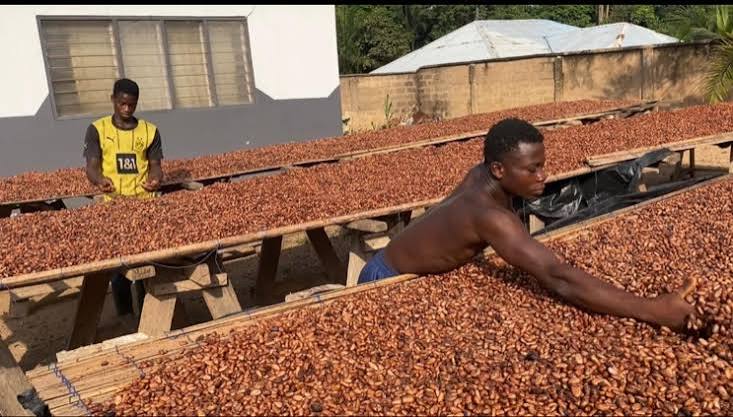
COCOBOD raised GH¢3.39 billion against its GH¢4 billion target, falling short by GH¢610 million. The shortfall raises concerns about investor appetite for its GH¢16.3 billion domestic funding programme, which aims to finance cocoa purchases and refinance existing debt while reducing reliance on foreign borrowing.
Finance Minister Dr. Cassiel Ato Forson is leading Ghana’s delegation to the 2026 IMF–World Bank Annual Meetings in Bangkok, Thailand. The discussions aim to build on Ghana’s economic stabilisation and support its transition towards sustained economic transformation ahead of the unveiling of its “New Economy” agenda.
Emerging Market Advisory says Ghana must improve access to foreign exchange, ensure predictable VAT refunds and streamline Customs processes to attract more investment. These reforms would help turn investor interest into stronger, more consistent capital inflows.
Bank of Ghana Governor Dr. Johnson Asiama says all 23 banks in Ghana now meet regulatory capital requirements, recovering from the impact of the Domestic Debt Exchange Programme. The banking sector has also recorded growth, with total assets rising 20.47% to GH¢500.20 billion by August 2026. The BoG is now focusing on strengthening banks’ risk management and ensuring they maintain sufficient capital to withstand future economic shocks.
PRIMARY DEBT MARKET ISSUANCE WEEK
Yields on Government of Ghana Treasury bills declined across all three tenors in the latest auction, held on 9 October 2026 for securities issued on 12 October 2026. The 91-day bill yield fell to 4.6042% from 4.6413% previously, while the 182-day bill declined to 6.2791% from 6.3193%. The 364-day bill also eased to 9.7523% from 9.8017%. Total bids tendered amounted to GH¢5.062 billion, compared with the government’s target of GH¢2.869 billion, while GH¢4.400 billion was accepted. Overall, yields continued to decline across the Treasury bill curve, with the largest reduction recorded on the 364-day bill at 4.94 basis points, followed by the 182-day bill at 4.02 basis points and the 91-day bill at 3.71 basis points.
| Security | Current Wk % | Previous Wk % | Bps |
|---|---|---|---|
| 91-Day GoG Bill | 4.6042 | 4.6413 | -3.71 |
| 182-Day GoG Bill | 6.2791 | 6.3193 | -4.02 |
| 364-Day GoG Bill | 9.7523 | 9.8017 | -4.94 |
Source(s): Bank of Ghana
GHANA FIXED INCOME MARKET VOLUME TRADED
The Ghana Fixed Income Market (GFIM) recorded approximately GH₵8.98 billion in traded volume across 24,638 transactions during the week. Treasury Bills accounted for the largest share of turnover at 46.68%, dominating transaction activity with 98.56% of all trades, reflecting their continued importance as highly liquid short-term government securities. DDEP Bonds contributed 44.51% of total traded volume across 0.69% of transactions, indicating that trading was concentrated in relatively large-value deals. Sell/Buy Back Trades involving GoG Notesand Bonds accounted for 7.62% of turnover and 0.38% of transactions, while New GoG Notes and Bonds contributed 0.87% of volume. Corporate Bonds and Old GoG Notes and Bonds recorded smaller shares of 0.31% and 0.01%, respectively. Overall, trading activity remained concentrated in Treasury Bills and DDEP Bonds, which together accounted for 91.19% of total traded volume, while Treasury Bills overwhelmingly dominated transaction activity throughout the week.
Daily Volume (GHS) Traded – GFIM
Week's Yield Curve
EQUITY MARKET
Trading activity on the Ghana Stock Exchange recorded approximately 24.81 million shares traded at a total value of GH₵141.88 million during the week. The Telecommunications sector led market activity with 20.40 million shares valued at GH₵129.81 million, accounting for approximately 91.50% of total traded value and 82.21% of total shares traded. The Financial sector followed with 2.14 million shares worth GH₵4.90 million, while Food & Beverage recorded 110,041 shares valued at GH₵2.22 million. Insurance traded 162,832 shares worth GH₵1.05 million, followed by Oil & Gas with 131,246 shares valued at GH₵1.03 million. Agriculture recorded 71,107 shares worth GH₵854,201, while Healthcare accounted for 730,207 shares valued at GH₵442,142. Advertising recorded 388,715 shares valued at GH₵209,522, while Technology traded 26,338 shares worth GH₵105,352. Mining recorded 5,560 shares valued at GH₵66,464, while Education recorded 35,009 shares valued at GH₵4,551. Manufacturing recorded no trading activity during the week. Overall, market activity remained heavily concentrated in Telecommunications, which dominated both traded volume and value, while the Financial sector ranked second by volume and value among the remaining sectors.
| Index | Level | WoW% | MoM% | YoY% |
|---|---|---|---|---|
| GSE-CI | 14,053.4800 | -0.128 | -0.623 | 60.240 |
| FSI | 7,416.2500 | -0.496 | -1.831 | 59.586 |
| Market Cap (Bn) | 266.4969 | -0.075 | -1.421 | 54.902 |
Source(s): Ghana Stock Exchange
Week's Equities Top Gainers & Laggards
EQUITY MARKET MOST TRADED STOCKS
| Ticker | Traded Volume | Price (GHS) |
|---|---|---|
| MTNGH | 20,397,641.00 | 6.45 |
| CAL | 1,172,534.00 | 0.73 |
| ETI | 767,325.00 | 1.54 |
| KASA | 614,389.00 | 1.92 |
| IIL | 607,069.00 | 0.55 |
Source(s): Ghana Stock Exchange
TOP PERFORMING AFRICAN STOCK INDICES YEAR-TO-DATE
| Country | Index | Level | YTD % |
|---|---|---|---|
| Zimbabwe | ZSE-ASI | 476.22 | +71.39 |
| Tanzania | DSE-ASI | 4,597.48 | +66.46 |
| Ghana | GSE-CI | 14,053.48 | +60.24 |
| Uganda | USE-ASI | 2,609.12 | +59.89 |
| Nigeria | NGX-ASI | 248,363.55 | +59.60 |
Source(s): African Markets
COMMODITY MARKET
Commodity markets reversed course this week. Brent crude closed at US$104.72 per barrel, up 2.42% from US$102.25 last week, when it had fallen 1.98%. It is 1.15% higher over the month and 72.1% higher year-on-year. Gold rebounded 1.3% to US$4,216.30 per ounce from US$4,162.30 last week, recovering part of last week’s 3.68% decline, while cocoa edged down 0.09% to US$5,665 per tonne from US$5,670 last week, after last week’s 0.91% gain. The movements reflect continued volatility in global energy markets amid Middle East tensions, shifting expectations for US monetary policy, and ongoing concerns about the 2026/27 cocoa crop in West Africa.
In Ghana, recent market developments continue to highlight the importance of commodity prices to the economy. Gold remains a major source of export earnings and foreign exchange inflows, and this week’s rebound offers some relief after last week’s sell-off, although the metal remains 2.87% lower year-on-year. Cocoa prices have strengthened 5.55% over the month, little changed from the 5.65% gain reported last week, and remain 6.6% lower year-on-year. Oil prices, meanwhile, moved higher again this week and remain significantly above a year ago, increasing pressure on fuel and transportation costs. These developments come as Ghana’s inflation rose to 5.2% in September from 5.0% in August, while the Bank of Ghana held its policy rate at 14% at its 24 September meeting.
Across Africa and global markets, elevated oil prices and currency pressures remain key concerns, while gold has bounced back this week despite trading well below its January 2026 record high. For Ghana, the combination of higher oil prices, a modest recovery in gold and steady cocoa prices presents mixed implications for export earnings, inflation and the exchange rate, compared with last week’s weaker gold and softer oil. Overall, commodity markets remain highly sensitive to geopolitical developments, global interest rate expectations and supply conditions, particularly in West Africa.
Source(s): Yahoo Finance, Trading Economics
CURRENCY MARKET
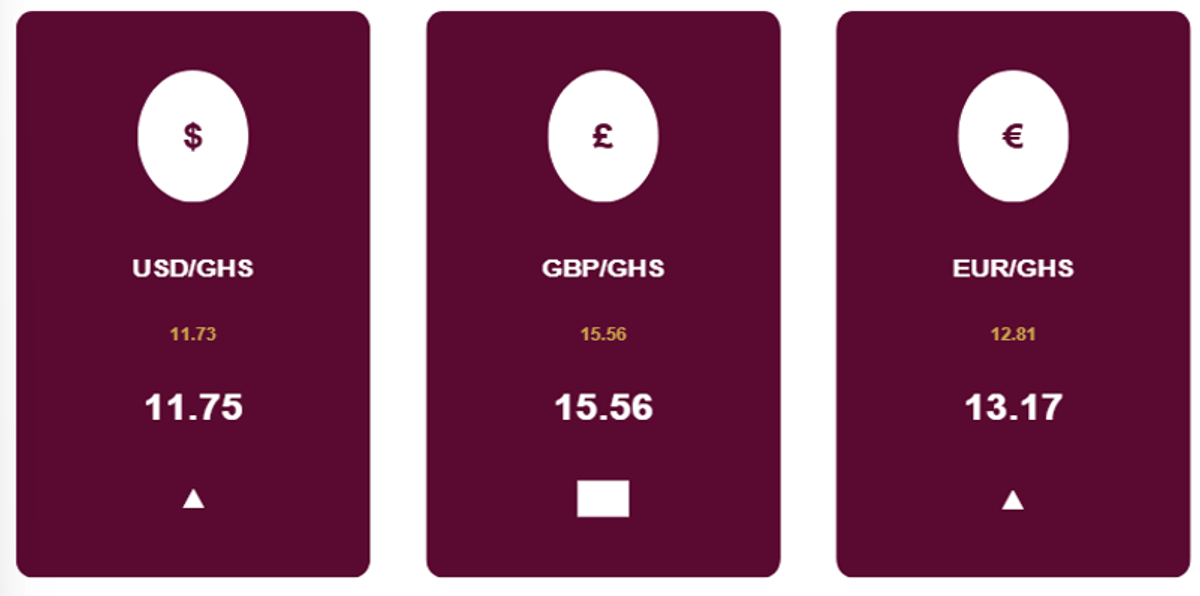
The Ghanaian cedi recorded mixed movements against the major trading currencies during the week. The USD/GHS rate stood at GH¢11.75, with the cedi depreciating by 0.17% week-on-week and 0.51% over both the month and quarter. On a year-on-year basis, the cedi weakened by 7.80% against the US dollar.
The EUR/GHS rate stood at approximately GH¢13.17, reflecting a 2.77% weekly depreciation of the cedi against the euro. The cedi also weakened by 2.02% over both the month and quarter, and 6.81% year-on-year.
The GBP/GHS rate stood at approximately GH¢15.56, with no recorded movement across the weekly, monthly, quarterly or yearly periods. Overall, the cedi weakened against the US dollar and euro across all measured periods, with the largest weekly depreciation recorded against the euro at 2.77%, while remaining unchanged against the pound.
Source(s): Bank of Ghana