KEY HEADLINES & INSIGHTS
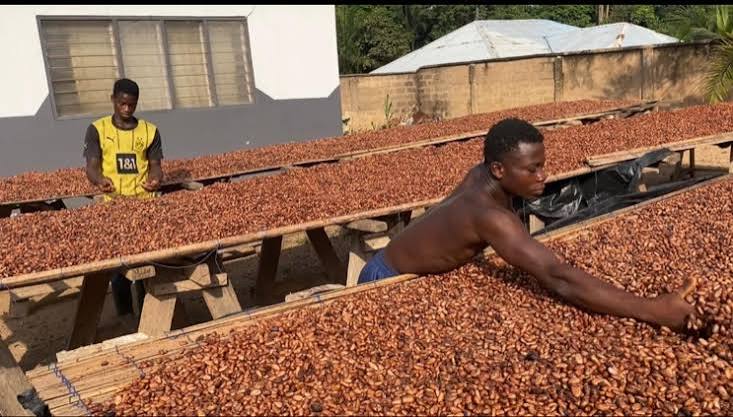
COCOBOD plans to use less than 60% of Ghana’s cocoa crop as collateral for financing. The new approach will raise up to GH¢16.3bn domestically in stages, reducing reliance on foreign loans and giving COCOBOD more flexibility to finance cocoa purchases.
Ghana wins $393m tax dispute against Tullow Oil. An international tribunal ruled in Ghana’s favour, requiring Tullow to pay the tax assessment. The win could boost government revenue and Ghana’s finances.
VRA returns to profit: The Volta River Authority reversed its GH₵105.75m loss in 2024 and recorded an GH₵88.04m profit in 2025, showing a significant improvement in its financial performance.
NLA pays GH¢10m dividend to government. The National Lottery Authority has presented GH¢10 million to the Consolidated Fund, marking its first dividend payment to the state since 2017 and providing additional revenue for government.
Russia’s oil earnings fall despite high oil prices. Oil and gas tax revenue dropped 17% to $64.4 billion in the first nine months of 2026. Lower oil production/exports linked to the Ukraine war and a stronger rouble are reducing Russia’s energy income, putting more pressure on its budget.
US Stock Market: The S&P 500 is around 7,708, up about 14% year-on-year. Stocks rallied after weak US jobs data reduced expectations of another Fed rate hike this month. However, high Treasury yields remain a key risk, so markets could stay volatile.
PRIMARY DEBT MARKET ISSUANCE WEEK
Yields on Government of Ghana Treasury bills declined across all three tenors in the latest auction held on 2 October 2026 for securities issued on 5 October 2026. The 91-day bill yield fell to 4.6413% from 4.6785% previously, while the 182-day bill declined to 6.3193% from 6.3701%. The 364-day bill also eased to 9.8017% from 9.8339%. Total bids tendered amounted to GH¢2.925 billion, compared with the government’s target of GH¢2.241 billion, while GH¢1.773 billion was accepted. Overall, yields continued to decline across the Treasury bill curve, with the largest reduction recorded on the 182-day bill at 5.08 basis points, followed by the 91-day bill at 3.72 basis points and the 364-day bill at 3.22 basis points.
| Security | Current Wk % | Previous Wk % | Bps |
|---|---|---|---|
| 91-Day GoG Bill | 4.6413 | 4.6785 | -3.72 |
| 182-Day GoG Bill | 6.3193 | 6.3701 | -5.08 |
| 364-Day GoG Bill | 9.8017 | 9.8339 | -3.22 |
Source(s): Bank of Ghana
GHANA FIXED INCOME MARKET VOLUME TRADED
The Ghana Fixed Income Market (GFIM) recorded approximately GH₵6.82 billion in traded volume across 1,750 transactions during the week. Treasury Bills accounted for the largest share of turnover at 53.34%, while also dominating transaction activity with 88.00% of all trades, reflecting their continued importance as highly liquid short-term government securities. DDEP Bonds accounted for 40.46% of total traded volume across 6.80% of transactions, indicating that activity in these securities was concentrated in relatively larger-value trades. Sell/Buy Back Trades involving GoG Notes & Bonds contributed 6.04% of total turnover across 3.09% of transactions, consistent with their role in short-term liquidity and funding management. Corporate Bonds accounted for 0.14% of traded volume and 1.20% of transactions, while New GoG Notes & Bonds contributed 0.02% of turnover across 0.40% of transactions. Old GoG Notes & Bonds remained marginal, accounting for 0.01% of total traded volume and 0.51% of transactions. Overall, the week's GFIM activity was heavily concentrated in Treasury Bills, which accounted for more than half of total traded volume and nearly nine-tenths of all transactions. DDEP Bonds remained the second largest contributor to turnover, generating a substantial share of traded volume through comparatively fewer transactions, while activity in the remaining security categories was relatively limited.
Daily Volume (GHS) Traded – GFIM
Week's Yield Curve
EQUITY MARKET
Trading activity on the Ghana Stock Exchange recorded 18.83 million shares traded at a total value of approximately GH₵104.63 million during the week. The Telecommunications sector led market activity with 14.52 million shares valued at GH₵94.47 million, making it the largest contributor to both traded volume and value and accounting for approximately 90.29% of total traded value. The Financial sector followed with 2.37 million shares worth GH₵4.86 million, while Insurance recorded 222,549 shares valued at GH₵1.41 million. Oil & Gas recorded 96,914 shares worth GH₵1.37 million, followed by Healthcare with 439,637 shares worth GH₵301,177. Food & Beverage recorded 17,095 shares valued at GH₵261,121, while Mining recorded 8,945 shares valued at GH₵228,696. Technology recorded 48,420 shares valued at GH₵193,662, while Agriculture accounted for 80,875 shares valued at GH₵180,558. Advertising recorded 349,022 shares valued at GH₵165,372. Trading activity in Manufacturing remained limited at 107,781 shares valued at GH₵32,119, while Education recorded only 130 shares valued at GH₵15.60. Overall, trading activity was heavily concentrated in the Telecommunications sector, which accounted for approximately 77.14% of total shares traded and 90.29% of total market value traded during the week.
| Index | Level | WoW% | MoM% | YoY% |
|---|---|---|---|---|
| GSE-CI | 14,071.4400 | 1.330 | -0.496 | 60.445 |
| FSI | 7,453.2500 | -1.444 | -1.341 | 60.383 |
| Market Cap (Bn) | 266.6983 | 0.160 | -1.346 | 55.019 |
Source(s): Ghana Stock Exchange
Week's Equities Top Gainers & Laggards
EQUITY MARKET MOST TRADED STOCKS
| Ticker | Traded Volume | Price (GHS) |
|---|---|---|
| MTNGH | 14,521,839.00 | 6.50 |
| CAL | 1,717,498.00 | 0.72 |
| KASA | 541,402.00 | 1.84 |
| ETI | 526,791.00 | 1.60 |
| DIGICUT | 349,022.00 | 0.51 |
Source(s): Ghana Stock Exchange
TOP PERFORMING AFRICAN STOCK INDICES YEAR-TO-DATE
| Country | Index | Level | YTD % |
|---|---|---|---|
| Zimbabwe | ZSE-ASI | 480.19 | +72.82 |
| Tanzania | DSE-ASI | 4,631.77 | +67.70 |
| Nigeria | NGX-ASI | 250,808.27 | +61.17 |
| Ghana | GSEC-CI | 14,071.44 | +60.45 |
| West Africa (BRVM) | BRVM-CI | 546.78 | +58.14 |
Source(s): African Markets
COMMODITY MARKET
Commodity markets recorded mixed performance over the past week. Brent crude closed at US$102.25 per barrel, down 1.98% week-on-week and 1.24% over the month, although it remained 68.04% higher year-on-year. Gold fell 3.68% to US$4,162.30 per ounce, while cocoa gained 0.91% to US$5,670 per tonne. The movements reflect continued volatility in global energy markets, changing monetary policy expectations and ongoing concerns about cocoa supply in West Africa.
In Ghana, recent market developments continue to highlight the importance of commodity prices to the economy. Gold remains a major source of export earnings and foreign exchange inflows, while cocoa prices have strengthened 5.65% over the month despite remaining 6.51% lower year-on-year. Oil prices, meanwhile, remain significantly higher than a year ago, increasing pressure on fuel and transportation costs. These developments come as Ghana's inflation rose to 5.0% in August, while the Bank of Ghana maintained its policy rate at 14%.
Across Africa and global markets, elevated oil prices and currency pressures remain key concerns, while gold has faced recent selling pressure despite its Longer term safe haven appeal. For Ghana, the combination of higher oil prices, weaker gold performance and a recovery in cocoa prices present mixed implications for export earnings, inflation and the exchange rate. Overall, commodity markets remain highly sensitive to geopolitical developments, global interest rate expectations and supply conditions, particularly in West Africa.
Source(s): Yahoo Finance, Trading Economics
CURRENCY MARKET
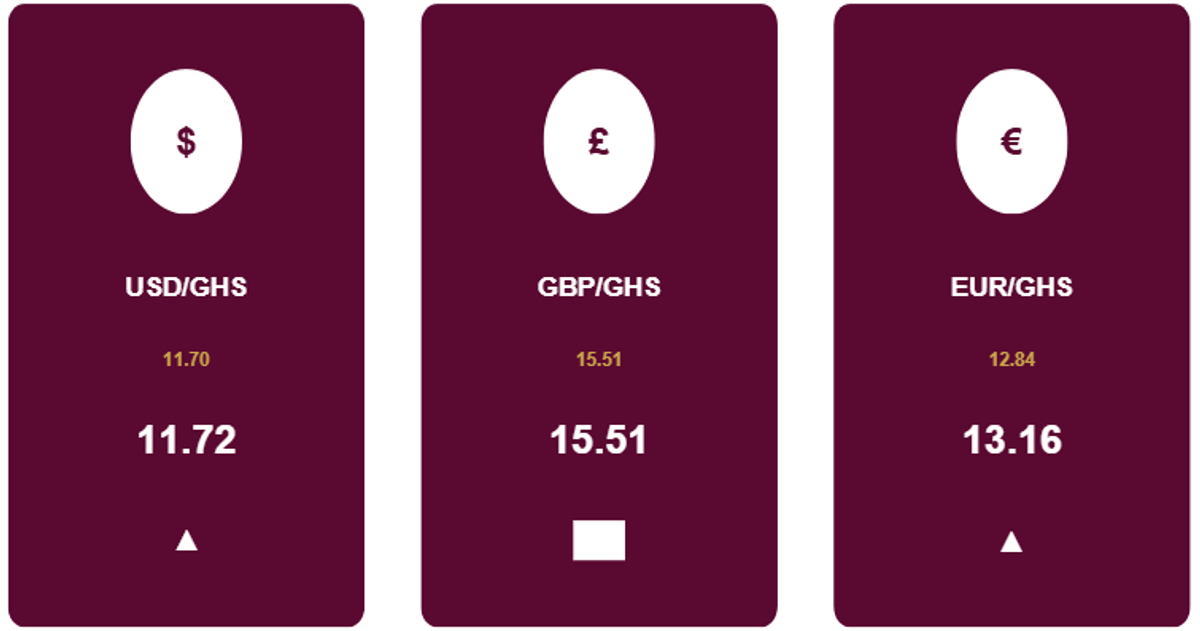
The Ghanaian cedi recorded mixed movements against the major trading currencies during the week. The USD/GHS rate stood at GH¢11.72, with the cedi depreciating by 0.17% week-on-week and 0.26% over the month and quarter. On a year-on-year basis, the cedi weakened by 7.52% against the US dollar.
The EUR/GHS rate stood at GH¢13.16, reflecting a 2.48% weekly depreciation of the cedi against the euro, while the cedi weakened by 1.96% over the month and quarter and 6.74% year-on-year.
The GBP/GHS rate stood at GH¢15.51, with no recorded movement across the weekly, monthly, quarterly or yearly periods. Overall, the cedi weakened against the US dollar and euro across all measured periods, with the largest weekly depreciation recorded against the euro at 2.48%, while remaining unchanged against the pound.
Source(s): Bank of Ghana