KEY HEADLINES & INSIGHTS
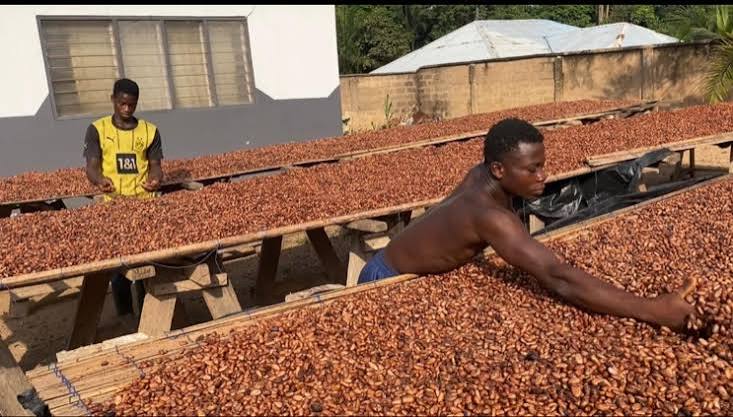
West Africa’s cocoa sector faces challenges meeting the EU’s anti-deforestation rules, which could raise compliance costs, disrupt exports and tighten cocoa supply, with Ghana, Côte d’Ivoire and Nigeria particularly exposed.
Gold prices edged higher on August 17, supported by a weaker U.S. dollar and reduced expectations of a Federal Reserve rate hike. Geopolitical tensions in the Middle East also supported demand for the safe-haven asset.
Minority Leader Alexander Afenyo-Markin has warned that GoldBod could become a major scandal, citing concerns over its operations and financial risks. His comments follow an IMF report indicating that losses from Ghana’s Domestic Gold Purchase Programme exceeded US$1.7 billion in 2025, equivalent to about 1.5% of GDP.
Genser Energy has secured EUR456 million in term and revolving credit facilities to finance its next phase of growth across West Africa. The funding is expected to support the company’s expansion and strengthen its integrated energy operations in the region.
The Bank of Ghana (BoG) has urged banks to channel improved financial conditions and rising credit growth into productive sectors, particularly SMEs and agricultural value chains, to support economic activity and growth.
PRIMARY DEBT MARKET ISSUANCE WEEK
Yields on Government of Ghana Treasury bills declined across all tenors this week, supported by strong liquidity and firm investor demand. The 91-day bill fell to 5.47% (-16.07bps), while the 182-day bill declined to 7.27% (-25.45bps). Similarly, the 364-day bill decreased to 12.50% (-48.64bps), indicating stronger demand across the curve. Overall, comfortable liquidity conditions and robust investor demand continued to drive yields lower across the Treasury bill market.
| Security | Current Wk % | Previous Wk % | Bps |
|---|---|---|---|
| 91-Day GoG Bill | 5.4682 | 5.6289 | -16.07 |
| 182-Day GoG Bill | 7.2720 | 7.5265 | -25.45 |
| 364-Day GoG Bill | 12.5000 | 12.9864 | -48.64 |
Source(s): Bank of Ghana
GHANA FIXED INCOME MARKET VOLUME TRADED
The Ghana Fixed Income Market (GFIM) recorded GH₵12.82 billion in traded volume across 7,472 transactions during the week, with DDEP Bonds accounting for the largest share of turnover at 67.42%, while representing only 3.28% of total transactions. This indicates that activity in DDEP Bonds remained concentrated in fewer but significantly larger-value trades, consistent with institutional participation in the secondary bond market. Treasury Bills accounted for 25.78% of total traded volume and dominated transaction activity with 95.48% of all trades, highlighting their higher trading frequency and greater liquidity relative to other securities traded on GFIM.Sell/Buy Back Trades contributed 6.22% of turnover and 0.88% of total transactions, while Corporate Bonds, Old GoG Notes & Bonds, and New GoG Notes & Bonds collectively accounted for 0.57% of traded volume. Overall, the week’s GFIM activity was driven by a combination of large-value DDEP Bond transactions and high-frequency Treasury Bill trading, with the concentration of turnover in DDEP Bonds and the significantly higher number of Treasury Bill transactions reflecting distinct trading patterns across the market.
Daily Volume (GHS) Traded – GFIM
Week's Yield Curve
EQUITY MARKET
Trading activity on the Ghana Stock Exchange recorded 10.06 million shares traded at a total value of GH₵31.35 million during the week, with the Healthcare sector leading activity at 2.56 million shares worth GH₵1.13 million. The Telecommunications sector followed with 2.27 million shares valued at GH₵15.97 million, making it the largest contributor to overall traded value, reflecting continued investor interest in the sector. The Financial sector recorded 1.66 million shares worth GH₵4.71 million, while Advertising contributed 1.10 million shares with a traded value of GH₵99,625. Agriculture recorded 685,522 shares worth GH₵1.46 million, followed by Oil & Gas with 178,612 shares valued at GH₵1.72 million. Other sectors recorded comparatively lower trading activity, including Insurance at 157,148 shares worth GH₵1.04 million, and Food & Beverage at 91,224 shares valued at GH₵1.74 million. Overall, the week’s activity was led by Healthcare and Telecommunications in terms of volume, while Telecommunications dominated traded value, indicating strong investor participation in the sector alongside notable activity in Healthcare and Financials.
| Index | Level | WoW% | MoM% | YoY% |
|---|---|---|---|---|
| GSE-CI | 15307.7100 | 0.792 | -0.824 | 74.541 |
| FSI | 8116.9800 | 1.194 | -1.470 | 74.665 |
| Market Cap (Bn) | 288.9045 | 1.428 | -1.233 | 67.926 |
Source(s): Ghana Stock Exchange
Week's Equities Top Gainers & Laggards
EQUITY MARKET MOST TRADED STOCKS
| Ticker | Traded Volume | Price (GHS) |
|---|---|---|
| IIL | 2,350,948.00 | 0.46 |
| MTNGH | 2,272,619.00 | 7.04 |
| KASA | 1,194,746.00 | 2.00 |
| DIGICUT | 1,100,000.00 | 0.13 |
| CAL | 1,042,682.00 | 0.78 |
Source(s): Ghana Stock Exchange
TOP PERFORMING AFRICAN STOCK INDICES YEAR-TO-DATE
| Country | Index | Level | YTD % |
|---|---|---|---|
| Ghana | GSE-CI | 15,307.7100 | +74.54 |
| Zimbabwe | ZSE-ASI | 475.62 | +71.17 |
| Nigeria | NGX-ASI | 242,619.20 | +55.91 |
| Tanzania | DSE-ASI | 4,232.85 | +53.26 |
| Namibia | NSE-ASI | 283.13 | +51.75 |
Source(s): African Markets
COMMODITY MARKET
Commodity markets recorded mixed performance during the week. Brent crude rose by more than 5% last week and remained around US$89 per barrel on 17 August, driven by renewed Middle East tensions and concerns over disruptions to oil shipments through the Strait of Hormuz. For Ghana, higher oil prices could support petroleum revenues but also increase domestic fuel costs.
Gold also remained firm, rising to around US$4,399 per ounce on 17 August as a weaker U.S. dollar and reduced expectations of a near-term Federal Reserve rate hike supported demand. This remains positive for Ghana given gold's importance to export earnings and foreign-exchange inflows.
Cocoa remains under pressure from Ghana's expected 16% decline in 2026/27 production, while new EU deforestation rules are creating additional challenges for West African cocoa exporters.
Overall, commodity developments remain mixed for Ghana, with higher oil prices supporting petroleum revenues, firm gold prices supporting export earnings, and cocoa facing supply and regulatory challenges.
Source(s): Yahoo Finance, Trading Economics
CURRENCY MARKET
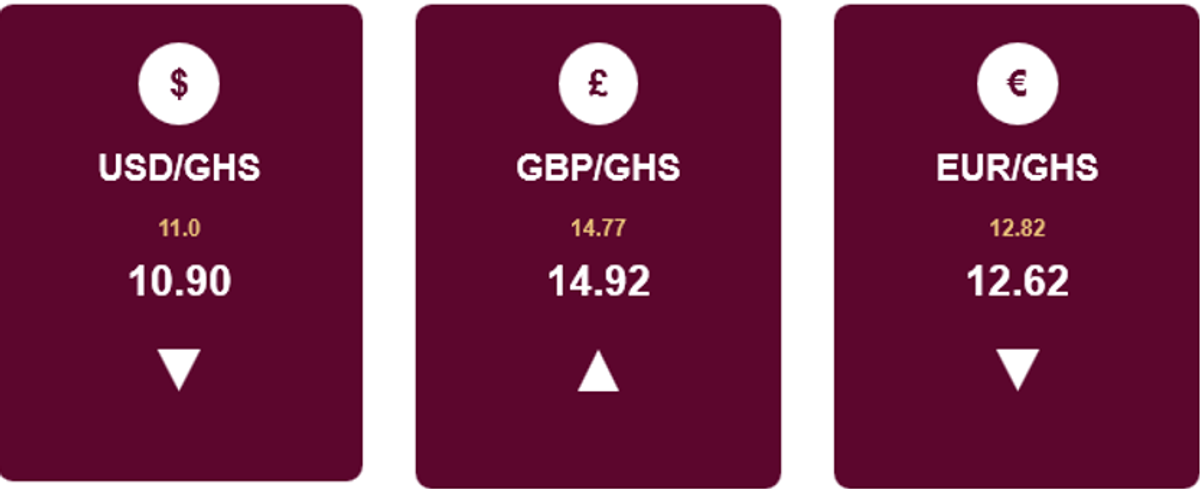
The Ghanaian cedi recorded mixed movements against the major trading currencies as of 17 August 2026. The USD/GHS rate stood at GH¢10.90, with the cedi depreciating by 0.91% over the week and 6.68% over the month. On a quarterly basis, the cedi weakened by 3.37%, while its yearly return was unchanged at 0.00%.
The EUR/GHS rate stood at GH¢12.62, reflecting a 1.49% weekly depreciation and a 5.66% monthly depreciation of the cedi against the euro. Over the quarter, the cedi depreciated by 2.00%, although it remained 2.38% stronger year-on-year.
The GBP/GHS rate stood at GH¢14.77, with no recorded movement across the weekly, monthly, quarterly, or yearly periods.
Overall, the cedi experienced short-term depreciation pressures against the US dollar and euro, with the most notable weakness recorded over the monthly period. However, its positive yearly performance against the euro and the stability of the pound rate provide some indication of resilience in selected currency markets.