KEY HEADLINES & INSIGHTS
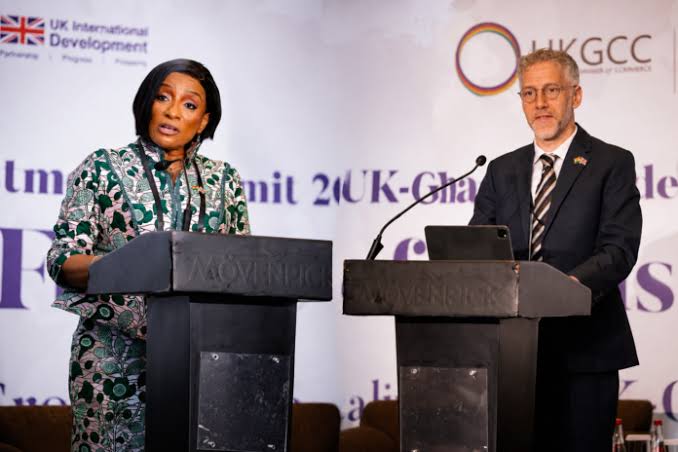
Trade between Ghana and the United Kingdom has exceeded £1.6 billion, with both countries seeking to strengthen their commercial relations. They aim to expand opportunities in investment, technology, agriculture and industrial development to promote economic growth and create more business opportunities.
The Ghana Revenue Authority (GRA) showcased its digital tax reforms at the 7th BRITACOF in Jakarta, Indonesia. The reforms use AI, digital identification and mobile payments to improve tax compliance and increase revenue. These innovations help reduce tax evasion and make tax payment easier, especially for informal businesses. The GRA also emphasized data protection, fairness and international cooperation.
Finance Minister Dr. Cassiel Ato Forson has stated that Ghana’s economic recovery must lead to decent jobs, higher incomes and increased production. He emphasized that the benefits of economic growth should improve living standards and create more opportunities for Ghanaians.
Ghanaian banks are shifting more resources towards lending as money market yields decline and reserve requirements change. This shift reflects lower returns on investments, encouraging banks to provide more loans to businesses and individuals. The move could support private sector growth and increase access to credit.
PRIMARY DEBT MARKET ISSUANCE WEEK
Yields on Government of Ghana Treasury bills showed mixed movements in the latest auction held on 16 October 2026 for securities to be issued on 19 October 2026. The 91-day bill yield increased to 4.6235% from 4.6042% previously, while the 182-day bill rose to 6.3154% from 6.2791%. In contrast, the 364-day bill yield declined to 9.7135% from 9.7523%. Total bids tendered amounted to GH¢5.173 billion, compared with the government’s target of GH¢5.019 billion, while GH¢4.400 billion was accepted. Overall, yields increased on the 91-day and 182-day bills but declined on the 364-day bill, with the largest increase recorded on the 182-day bill at 3.63 basis points, followed by the 91-day bill at 1.93 basis points, while the 364-day bill recorded a decrease of 3.88 basis points.
| Security | Current Wk % | Previous Wk % | Bps |
|---|---|---|---|
| 91-Day GoG Bill | 4.6235 | 4.6042 | + 1.93 |
| 182-Day GoG Bill | 6.3154 | 6.2791 | + 3.63 |
| 364-Day GoG Bill | 9.7135 | 9.7523 | - 3.88 |
Source(s): Bank of Ghana
GHANA FIXED INCOME MARKET VOLUME TRADED
The Ghana Fixed Income Market (GFIM) recorded approximately GH₵7.15 billion in traded volume across 4,330 transactions during the week. DDEP Bonds accounted for the largest share of turnover at 55.48%, representing 3.95% of all transactions, indicating that trading was concentrated in relatively large value deals. Treasury Bills contributed 41.07% of total traded volume while dominating transaction activity with 94.04% of all trades, reflecting their continued importance as highly liquid short-term government securities. Sell/Buy Back Trades involving all GoG Notes and Bonds accounted for 3.16% of turnover and 1.15% of transactions. Corporate Bonds contributed 0.14% of traded volume, while New GoG Notes and Bonds and Commercial Paper each accounted for 0.07%. Old GoG Notes and Bonds recorded no trading activity during the week. Overall, trading activity remained concentrated in DDEP Bonds and Treasury Bills, which together accounted for 96.55% of total traded volume, with Treasury Bills overwhelmingly dominating transaction activity throughout the week.
Daily Volume (GHS) Traded – GFIM
Week's Yield Curve
EQUITY MARKET
Trading activity on the Ghana Stock Exchange recorded approximately 16.85 million shares traded at a total value of GH₵67.21 million during the week. The Telecommunications sector led market activity with 6.97 million shares valued at GH₵45.54 million, accounting for approximately 67.76% of total traded value and 41.35% of total shares traded. The Financial sector followed with 2.22 million shares worth GH₵5.75 million, while Healthcare recorded 730,181 shares valued at GH₵567,079.99. Advertising traded 206,811 shares worth GH₵105,289.95, while Food & Beverage recorded 121,653 shares valued at GH₵1.41 million. Insurance traded 98,455 shares worth GH₵640,834.93, followed by Oil & Gas with 71,750 shares valued at GH₵734,094.49. Agriculture recorded 51,080 shares worth GH₵137,798.20, while Technology accounted for 38,803 shares valued at GH₵155,212.00. Mining recorded 3,856 shares valued at GH₵46,507.74, while Manufacturing traded 6,224 shares worth GH₵2,103.40. Education recorded minimal activity, with 22 shares traded at a value of GH₵2.86. Overall, market activity remained heavily concentrated in Telecommunications, which dominated both traded volume and value, while the Financial sector ranked second in traded volume and value among the reported sectors.
| Index | Level | WoW% | MoM% | YoY% |
|---|---|---|---|---|
| GSE-CI | 14,394.7700 | 2.429 | 1.791 | 64.132 |
| FSI | 7,498.5400 | 1.110 | -0.742 | 61.357 |
| Market Cap (Bn) | 271.2557 | 1.786 | 0.340 | 57.668 |
Source(s): Ghana Stock Exchange
Week's Equities Top Gainers & Laggards
EQUITY MARKET MOST TRADED STOCKS
| Ticker | Traded Volume | Price (GHS) |
|---|---|---|
| MTNGH | 6,967,107.00 | 6.73 |
| KASA | 6,273,137.00 | 1.89 |
| ETI | 1,340,514.00 | 1.55 |
| CAL | 784,350.00 | 0.73 |
| IIL | 377,700.00 | 0.61 |
Source(s): Ghana Stock Exchange
TOP PERFORMING AFRICAN STOCK INDICES YEAR-TO-DATE
| Country | Index | Level | YTD % |
|---|---|---|---|
| Zimbabwe | ZSE-ASI | 475.30 | +71.06 |
| Tanzania | DSE-ASI | 4,572.74 | +65.56 |
| Ghana | GSE-CI | 14,394.77 | +64.13 |
| Nigeria | NGX-ASI | 247,539.73 | +59.07 |
| Uganda | BRVM-CI | 2,567.33 | +57.33 |
Source(s): African Markets
COMMODITY MARKET
Commodity markets recorded mixed performance during the week, with Brent crude rising while gold and cocoa prices declined. Brent crude closed at US$109.86 per barrel, up 4.91% for the week, 6.11% over the month and quarter, and 80.54% year-on-year. Gold fell 0.83% to US$4,181.10 per ounce, while cocoa declined 0.35% to US$5,645 per tonne. Despite these weekly declines, cocoa remained up 5.18% over the month and quarter, while gold and cocoa were down 3.69% and 6.92% year-on-year, respectively.
For Ghana, rising oil prices could increase fuel import costs, transportation expenses and production costs, potentially putting pressure on domestic inflation and the external balance. Gold remains a major source of export earnings and foreign exchange, while cocoa prices influence export receipts and the livelihoods of farmers. However, despite cocoa's recent monthly recovery, its year-on-year decline highlights continued uncertainty in the sector. The overall impact on Ghana will depend on actual export volumes, realised prices, import costs and movements in the exchange rate.
These developments are relevant to Ghana's current economic conditions, as inflation rose to 5.2% in September 2026 from 5.0% in August. Higher global oil prices could complicate efforts to maintain price stability, while fluctuations in gold and cocoa prices may affect foreign exchange inflows and export earnings. Overall, commodity market movements remain an important external risk for Ghana, with geopolitical tensions, global demand and supply conditions likely to influence the outlook for inflation, the exchange rate and economic stability.
Source(s): Yahoo Finance, Trading Economics
CURRENCY MARKET
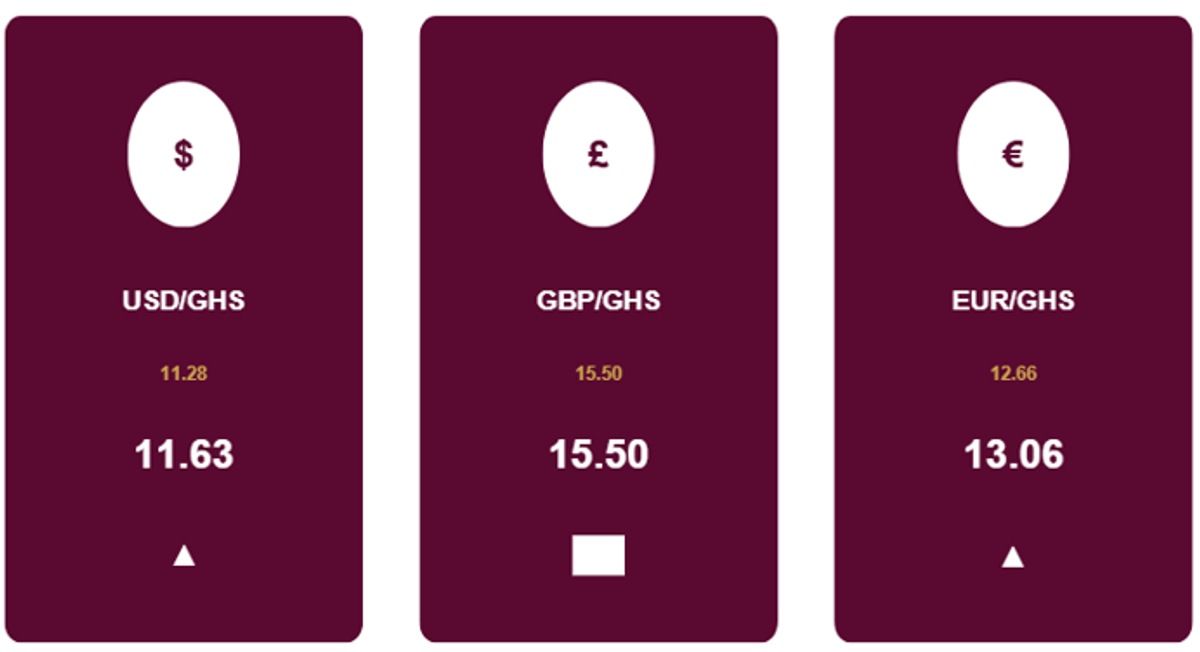
The Ghanaian cedi recorded mixed movements against the major trading currencies during the week. The USD/GHS rate stood at GH¢11.63, with the cedi depreciating by 3.07% week-on-week, 0.51% over the month and quarter, and 6.70% year-on-year.
The EUR/GHS rate stood at GH¢13.06, reflecting a weekly depreciation of 3.14%, while the cedi weakened by 1.14% over the month and quarter and 5.88% year-on-year.
Meanwhile, the GBP/GHS rate remained unchanged at GH¢15.50 across all measured periods. Recent developments indicate that gold related foreign exchange inflows have supported the cedi, although currency movements remain sensitive to foreign exchange supply and demand, import payments and global market conditions. Overall, the supplied data indicate depreciation against the US dollar and euro, while the pound remained unchanged.
Source(s): Bank of Ghana