KEY HEADLINES & INSIGHTS
Ghana’s latest Treasury bill auction recorded exceptionally strong investor demand, with GH¢14.27 billion in bids against a GH¢5.43 billion target, representing a 162.9% oversubscription. The government accepted GH¢5.85 billion, while rejecting about GH¢8.41 billion, with the 364-day bill attracting the most interest. Strong liquidity, partly linked to recent Domestic Debt Exchange Programme coupon payments, pushed yields lower across all maturities, with the 91-day, 182-day and 364-day bills falling to 5.08%, 7.08% and 11.59%, respectively. The strong demand and falling yields indicate improved liquidity and investor confidence in government securities, while reducing the Treasury’s borrowing costs
Stakeholders have proposed a Ghana–China Zero-Tariff Fund to help Ghanaian businesses, especially SMEs, overcome financing challenges and boost exports to China. The fund would support production, processing, warehousing and other parts of the export value chain, with institutions such as Ghana EXIM Bank and Development Bank Ghana encouraged to play a stronger role.
PETROSOL Platinum Energy PLC is listing a GH¢200 million note programme on the Ghana Stock Exchange’s Fixed Income Market, providing the company with an alternative source of long-term financing. The debt listing will help fund its expansion while giving investors another opportunity to invest in Ghana’s energy sector without taking an ownership stake in the company.
PRIMARY DEBT MARKET ISSUANCE WEEK
Yields on Government of Ghana Treasury bills declined across all tenors this week, supported by strong liquidity and firm investor demand. The 91-day bill fell to 5.08% (-38.87bps), while the 182-day bill declined to 7.08% ( 19.20bps). Similarly, the 364-day bill decreased to 11.59% (-90.70bps), reflecting stronger demand across the curve. Overall, comfortable liquidity conditions and robust investor demand continued to drive yields lower across the Treasury bill market.
| Security | Current Wk % | Previous Wk % | Bps |
|---|---|---|---|
| 91-Day GoG Bill | 5.0795 | 5.4682 | - 38.87 |
| 182-Day GoG Bill | 7.0800 | 7.2720 | - 19.20 |
| 364-Day GoG Bill | 11.5930 | 12.5000 | -90.70 |
Source(s): Bank of Ghana
GHANA FIXED INCOME MARKET VOLUME TRADED
The Ghana Fixed Income Market (GFIM) recorded GH₵9.94 billion in traded volume across 4,758 transactions during the week, with Treasury Bills accounting for the largest share of turnover at 58.22% and dominating transaction activity with 90.37% of all trades. This reflects the strong preference for short-term government securities in Ghana, supported by their high liquidity, regular weekly issuance and continued investor demand as the Government relies heavily on T-Bills for domestic financing. DDEP Bonds accounted for 36.21% of traded volume but only 5.42% of transactions, indicating fewer but significantly larger-value trades, reflecting institutional participation and renewed activity in Ghana’s domestic bond market as the country gradually returns to longer-term borrowing following the debt restructuring. Sell/Buy Back Trades contributed 5.43% of turnover and 3.40% of transactions, mainly reflecting short-term liquidity management, while Corporate Bonds, Old GoG Notes & Bonds, and New GoG Notes & Bonds collectively accounted for only 0.13% of traded volume. Overall, the week’s GFIM activity was driven by strong demand and liquidity in Treasury Bills alongside larger-value DDEP Bond transactions, reflecting Ghana’s current shift between short term financing needs and the gradual recovery of the longer-term domestic bond market.
Daily Volume (GHS) Traded – GFIM
Week's Yield Curve
EQUITY MARKET
Trading activity on the Ghana Stock Exchange recorded 17.87 million shares traded at a total value of GH₵76.91 million during the week, with the Telecommunications sector leading activity at 6.78 million shares worth GH₵47.58 million, making it the largest contributor to both traded volume and value. This strong performance reflects continued investor interest in the sector and the significant market value of telecommunications stocks. Advertising followed with 4.21 million shares valued at GH₵673,705, while the financial sector recorded 1.97 million shares worth GH₵17.26 million, making it the second-largest contributor to traded value. Healthcare recorded 2.60 million shares worth GH₵1.78 million, while Agriculture contributed 744,753 shares valued at GH₵860,206. Other sectors recorded comparatively lower activity, including Insurance at 272,577 shares worth GH₵1.87 million, Oil & Gas at 89,784 shares valued at GH₵2.41 million, and Manufacturing at 150,001 shares worth GH₵29,000. Overall, the week’s activity was dominated by Telecommunications and Financials in terms of traded value, while Telecommunications and Advertising led in volume, highlighting strong investor participation in these sectors.
| Index | Level | WoW% | MoM% | YoY% |
|---|---|---|---|---|
| GSE-CI | 15,136.7200 | -1.117 | -1.932 | 72.592 |
| FSI | 7,925.0500 | -2.365 | -3.800 | 70.535 |
| Market Cap (Bn) | 286.8254 | -0.720 | -1.944 | 66.718 |
Source(s): Ghana Stock Exchange
Week's Equities Top Gainers & Laggards
EQUITY MARKET MOST TRADED STOCKS
| Ticker | Traded Volume | Price (GHS) |
|---|---|---|
| MTNGH | 6,783,450.00 | 7.00 |
| DIGICUT | 4,206,763.00 | 0.18 |
| IIL | 2,258,438.00 | 0.65 |
| CAL | 1,021,441.00 | 0.76 |
| KASA | 864,284.00 | 1.97 |
Source(s): Ghana Stock Exchange
TOP PERFORMING AFRICAN STOCK INDICES YEAR-TO-DATE
| Country | Index | Level | YTD % |
|---|---|---|---|
| Ghana | GSE-CI | 15,136.72 | +72.59 |
| Zimbabwe | ZSE-ASI | 474.92 | +70.92 |
| Tanzania | DSE-ASI | 4,250.04 | +53.88 |
| Nigeria | NGX-ASI | 239,351.16 | +53.81 |
| West Africa (BRVM) | BRVM-CI | 529.15 | +53.04 |
Source(s): African Markets
COMMODITY MARKET
Commodity markets recorded broad-based gains during the week. Brent crude rose 6.63% to US$94.39 per barrel, supported by heightened U.S. Iran tensions and concerns over disruptions to oil flows through the Strait of Hormuz. For Ghana, higher oil prices could support petroleum revenues but may also increase domestic fuel costs.
Gold increased 5.56% to US$4,624.10 per ounce, supported by safe haven demand, a weaker U.S. dollar and expectations of lower U.S. interest rates. The continued strength in gold prices remains positive for Ghana’s export earnings and foreign-exchange inflows.
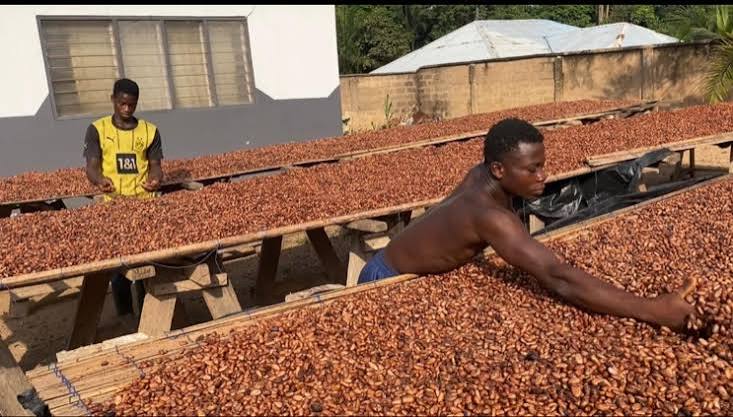
Cocoa also gained 4.46% to US$5,990 per tonne, driven by concerns over tighter West African supplies amid adverse weather conditions and expectations of lower production in Ghana and Côte d’Ivoire.
Source(s): Yahoo Finance, Trading Economics
CURRENCY MARKET
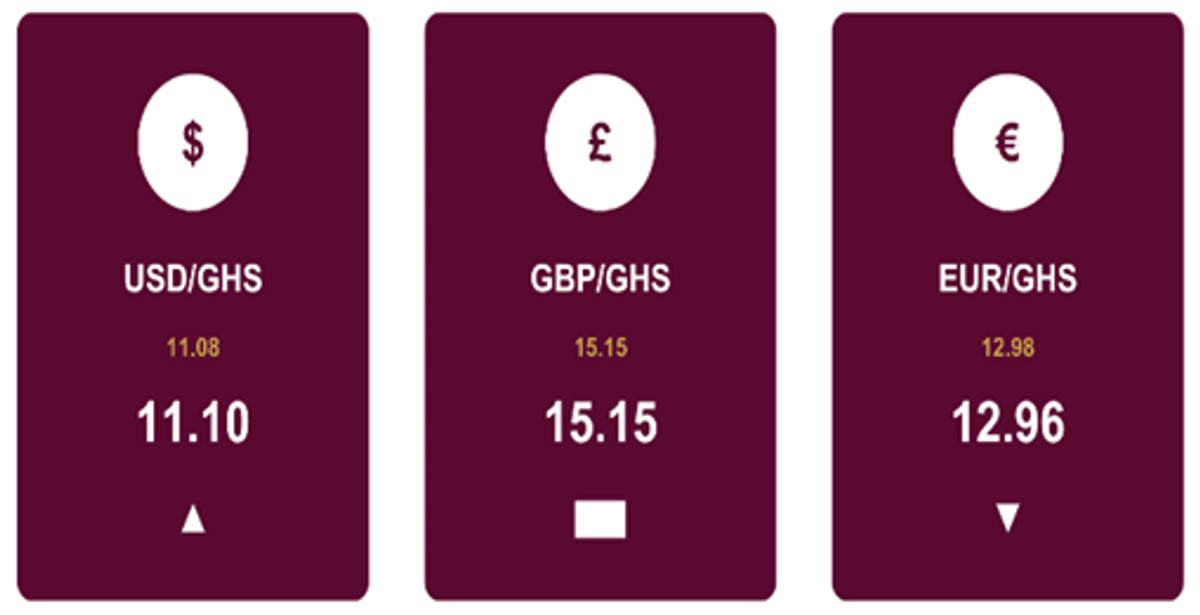
The Ghanaian cedi recorded mixed movements against the major trading currencies. The USD/GHS rate stood at GH¢11.10, with the cedi unchanged over the week but depreciating by 4.97% over the month. On a quarterly basis, the cedi strengthened by 1.60%, while its yearly performance reflected a 1.83% depreciation. The EUR/GHS rate stood at GH¢12.97, reflecting a 0.14% weekly and 3.07% monthly depreciation of the cedi against the euro. Over the quarter, the cedi appreciated by 0.68% and strengthened by 5.19% year-on-year. The GBP/GHS rate stood at GH¢15.15, remaining unchanged across the weekly, monthly, quarterly and yearly periods. Overall, the cedi remained broadly stable in the short term, with notable monthly depreciation against the US dollar and euro. However, its quarterly appreciation against both currencies and stability against the pound indicate some resilience in the foreign-exchange market.
Source(s): Bank of Ghana