KEY HEADLINES & INSIGHTS
Universal Merchant Bank (UMB) has become the first bank in Ghana approved by both the Bank of Ghana (BoG) and the Securities and Exchange Commission (SEC) to offer virtual accounts, enabling it to provide regulated banking services to eligible virtual asset businesses, fintechs and technology companies. The move aligns with Ghana’s efforts to establish a regulated framework for virtual assets while supporting innovation and strengthening oversight in the sector. The approval also gives UMB an early-mover advantage in providing banking infrastructure to businesses operating within Ghana’s growing digital asset ecosystem.
Ghana’s downstream petroleum sector is facing mounting margin and working-capital pressures after the NPA raised indicative fuel price floors, with petrol increasing by 9.4% to GH¢14.53 per litre and diesel by 18.3% to GH¢16.97, driven by higher global crude oil prices and cedi depreciation. The increase has raised inventory financing costs for OMCs and intensified competition, with some operators reportedly selling at very low or negative margins to protect market share. The development highlights the sector’s vulnerability to exchange-rate movements and global oil prices, increasing pressure on OMCs to strengthen cost and liquidity management.
The Bank of Ghana (BoG) is developing a framework to incentivise commercial banks to list on the Ghana Stock Exchange (GSE), Governor Dr. Johnson Pandit Asiama has disclosed. The initiative aims to improve transparency and corporate governance while strengthening banks’ access to long-term domestic capital and deepening Ghana’s capital market.
PRIMARY DEBT MARKET ISSUANCE WEEK
Yields on Government of Ghana Treasury bills declined across all tenors this week, supported by strong investor demand and comfortable liquidity conditions. The 91-day bill fell to 4.95%(-13.35bps), while the 182-day bill declined to 6.86%(-22.13bps). Similarly, the 364-day bill decreased to 10.78% (-81.52bps), reflecting stronger demand, particularly at the longer end of the curve. Overall, ample liquidity and firm investor appetite for government securities continued to drive yields lower.
| Security | Current Wk % | Previous Wk % | Bps |
|---|---|---|---|
| 91-Day GoG Bill | 4.9460 | 5.0795 | -13.35 |
| 182-Day GoG Bill | 6.8587 | 7.0800 | -22.13 |
| 364-Day GoG Bill | 10.7778 | 11.5930 | -81.52 |
Source(s): Bank of Ghana
GHANA FIXED INCOME MARKET VOLUME TRADED
The Ghana Fixed Income Market (GFIM) recorded GH₵11.71 billion in traded volume across 14,475 transactions during the week, with DDEP Bonds accounting for the largest share of turnover at 57.21%, while Treasury Bills dominated transaction activity with 96.39% of all trades. This reflects the continued strong preference for short-term government securities in Ghana, supported by their high liquidity, regular weekly issuance and sustained investor demand. DDEP Bonds accounted for 57.21% of traded volume but only 2.15% of transactions, indicating fewer but significantly larger-value trades, reflecting continued institutional activity and interest in Ghana’s restructured domestic bond market. Sell/Buy Back Trades contributed 11.43% of turnover and 1.21% of transactions, mainly reflecting short-term liquidity management, while Old GoG Notes & Bonds, New GoG Notes & Bonds, and Corporate Bonds collectively accounted for only 0.55% of traded volume. Overall, the week’s GFIM activity was driven by large-value DDEP Bond transactions alongside strong trading activity in Treasury Bills, reflecting continued investor demand for short-term instruments and selective participation in the longer-term domestic bond market.
Daily Volume (GHS) Traded – GFIM
Week's Yield Curve
EQUITY MARKET
Trading activity on the Ghana Stock Exchange recorded 8.29 million shares traded at a total value of GH₵39.13 million during the week, with the Telecommunications sector leading activity at 3.21 million shares worth GH₵22.22 million, making it the largest contributor to both traded volume and value. This strong performance reflects continued investor interest in the sector and the significant market value of telecommunications stocks. Healthcare followed with 1.75 million shares valued at GH₵1.73 million, while the financial sector recorded 1.54 million shares worth GH₵7.22 million, making it the second-largest contributor to traded value. Insurance recorded 456,865 shares worth GH₵2.86 million, while Agriculture contributed 292,747 shares valued at GH₵487,419. Other sectors recorded comparatively lower activity, including Food & Bev at 99,179 shares worth GH₵1.38 million, Oil & Gas at 89,589 shares valued at GH₵970,215, and Technology at 79,500 shares worth GH₵510,342. Overall, the week’s activity was dominated by Telecommunications and Financials in terms of traded value, while Telecommunications and Healthcare led in volume, highlighting continued investor participation in these sectors.
| Index | Level | WoW% | MoM% | YoY% |
|---|---|---|---|---|
| GSE-CI | 15,020.4100 | -0.768 | -2.685 | 71.265 |
| FSI | 7,890.6400 | -0.434 | -4.217 | 69.795 |
| Market Cap (Bn) | 284.0337 | -0.973 | -2.898 | 65.095 |
Source(s): Ghana Stock Exchange
Week's Equities Top Gainers & Laggards
EQUITY MARKET MOST TRADED STOCKS
| Ticker | Traded Volume | Price (GHS) |
|---|---|---|
| MTNGH | 3,212,523.00 | 6.91 |
| IIL | 1,291,151.00 | 0.75 |
| CAL | 749,707.00 | 0.75 |
| KASA | 697,150.00 | 1.98 |
| DASPHARMA | 457,613.00 | 1.98 |
Source(s): Ghana Stock Exchange
| Country | Index | Level | YTD % |
|---|---|---|---|
| Ghana | GSE-CI | 15,020.41 | +71.27 |
| Zimbabwe | ZSE-ASI | 466.46 | +67.88 |
| Tanzania | DSE-ASI | 4,444.48 | +60.92 |
| Nigeria | NGX-ASI | 241,298.47 | +55.06 |
| West Africa (BRVM) | BRVM-CI | 530.06 | +53.31 |
Source(s): African Markets
COMMODITY MARKET
Commodity developments remained mixed but continued to have important implications for Ghana’s external position. Brent crude closed at US$89.31 per barrel, declining 5.38% over the week and 0.9% over the month, although it remained significantly higher over the quarter and year. For Ghana, the recent moderation in oil prices could ease pressure on the country’s petroleum import bill and domestic fuel prices. However, the still-elevated year-on-year price means oil remains a potential source of inflationary and external-sector pressure, even as higher crude prices support Ghana’s upstream petroleum revenues.
Gold closed at US$4,478.10 per ounce, down 3.16% weekly but up 10.59% over the month. The recent decline was mainly linked to a stronger U.S. dollar and changing expectations around U.S. interest rates. Despite the weekly correction, the sustained strength in gold prices remains favourable for Ghana, as gold is the country’s largest merchandise export and a major source of foreign-exchange inflows. Higher gold prices therefore provide continued support to Ghana’s trade balance, international reserves and the cedi, particularly if export volumes remain strong.
Cocoa recorded the strongest performance, rising 8.96% weekly, 20.94% monthly and 30.49% quarterly to US$6,527 per tonne. The increase is particularly significant for Ghana given concerns about cocoa production, including disease, weather conditions and challenges affecting the 2026/27 crop. Higher cocoa prices could help cushion the impact of lower production on export receipts and support the sector’s contribution to foreign-exchange earnings. Overall, the commodity outlook is broadly supportive for Ghana, with strong gold and cocoa prices providing important export and FX support, while oil prices remain a key risk to inflation and the import bill.
Source(s): Yahoo Finance, Trading Economics
CURRENCY MARKET
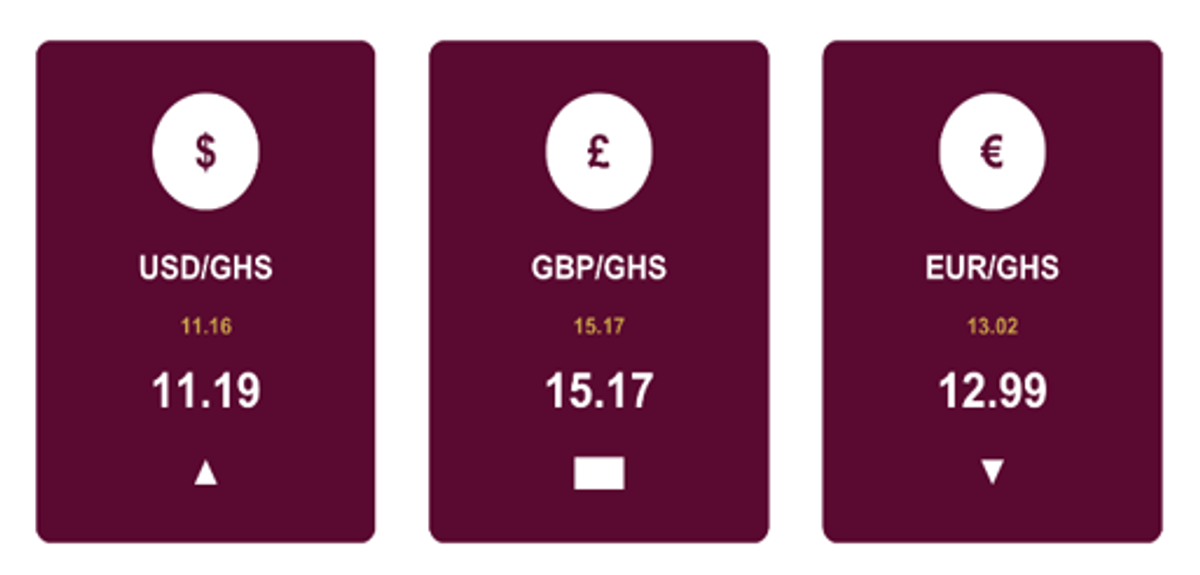
The Ghanaian cedi recorded mixed movements against the major trading currencies. The USD/GHS rate stood at GH¢11.20, with the cedi appreciating by 4.11% over the month and 0.71% over the quarter, despite a 0.36% weekly depreciation and 2.75% weakening year-on-year. Against the euro, EUR/GHS stood at GH¢12.99, with the cedi strengthening 2.96% monthly and 0.80% quarterly, although it remained 5.32% weaker year-on-year.
The GBP/GHS rate stood at GH¢15.17, with no recorded movement across the weekly, monthly, quarterly, or yearly periods. Overall, the cedi has shown improved short-term stability, particularly against the dollar and euro, supported by recent appreciation over the monthly and quarterly periods. This could help moderate imported inflation and improve foreign-exchange conditions, although the year-on-year depreciation against the dollar and euro indicates that underlying exchange-rate pressures remain.
Source(s): Bank of Ghana